
How To Find The Best Suppliers, A Practical Workflow and Scorecard
How to find the best suppliers comes down to using a repeatable workflow: define what “best” means for your business, discover candidates, verify them with evidence, then compare them with a simple weighted scorecard before you commit.
- Define “best supplier” by your model (manufacturer vs wholesaler vs distributor) so you do not optimize for the wrong thing.
- Vetting should be evidence-led: business identity, web presence, trade signals, and clear red flags before you spend time on RFQs.
- A lightweight weighted scorecard makes decisions objective and easier to defend internally.
What “Best Supplier” Means for Your Business Model
Best supplier selection starts by matching the supplier type to your business model, because “best” for a reseller (availability and margin) is different from “best” for a brand (capability and repeatable quality).
Stage 1 checklist: Define your sourcing goal before you contact anyone
- Write your primary goal in one line (examples: “lowest landed cost at stable quality,” “fast replenishment,” “custom product,” “risk reduction,” “sustainable materials”).
- Define your success metrics (examples: target gross margin %, max defect rate you can tolerate, max lead time, max MOQ, target delivery window).
- Define your constraints (country restrictions, required materials, required packaging, compliance expectations for your market).
Stage 2 checklist: Pick the right supplier category
Use the category below as a decision rule, not as labels. The same company can play multiple roles, so confirm what they actually do.
- Manufacturer: best when you need customization, stable specs, and long-term cost control. Confirm directly with the supplier: what processes are in-house vs subcontracted, and which factory address produces your SKU.
- Wholesaler / trading company: best when you want speed, mixed SKUs, and lower operational burden. Confirm directly: whether they own inventory, and who the actual factory is if you need audits.
- Distributor / authorized reseller: best when you need branded goods, local stock, and predictable lead times. Confirm directly: authorization proof, warranty process, and territory limitations.
Stage 3 checklist: Set your “walk-away” thresholds
- Max acceptable MOQ (per SKU and per order) based on cash flow and inventory risk.
- Max acceptable lead time and your buffer (production + transit + customs).
- Payment terms you will not exceed (example: you may allow deposit + balance, but only with clear milestones and documentation).
- Quality gate (example: no shipment without agreed inspection criteria, photos, or third-party report).
Where to Find Suppliers Fast Online and Offline
How to find the best suppliers efficiently requires using multiple channels in parallel, because each channel has different signal quality and different failure modes.
Stage 1 checklist: Build your discovery map (channels + what they are good for)
- Trade databases and customs shipment signals: strong for export experience and repeat activity; weaker for new exporters. Use when reliability matters more than novelty.
- Industry trade shows and exhibitor lists: strong for meeting decision-makers and seeing product lines; weaker for quick comparison. Use when you need differentiation and serious suppliers.
- Online marketplaces: strong for fast initial options; weaker for verification. Use to create a longlist, not to finalize.
- Google + niche directories: strong for specialized factories; weaker because marketing pages can mislead. Use when you need a specific process or material.
- Referrals: strong for trust and tacit knowledge; weaker because the referral may fit someone else’s constraints. Use to shorten vetting time, not to skip it.
Stage 2 checklist: Turn a messy search into a structured longlist
- Create a longlist sheet with columns: supplier name, website, country, supplier type (manufacturer/wholesaler/distributor), product fit, contact, source channel, and “evidence links.”
- Record the first evidence you see (factory address, product catalog, export markets, any certification claims). Do not treat claims as verified.
- Capture initial pricing signals cautiously: if a quote is far below market, mark it as “needs explanation,” not “great deal.”
Stage 3 checklist: Use the right “next step” for each channel
- From a trade show lead: request factory address, core processes, and top 3 export markets before asking for a full quote.
- From a marketplace lead: ask who manufactures the product, then request a factory profile and recent production photos tied to your product category.
- From a trade database lead: shortlist based on repeat shipments and product match, then validate identity and capacity in the next section.
For deeper discovery reading, use this guide on where to look for suppliers and this framework for how to look for suppliers when you need a repeatable process.
The Online Vetting Playbook Most Guides Skip
Online vetting works best when you treat every claim as unverified until you can tie it to a document, a registry entry, or a consistent set of trade and web signals.
Stage 1 checklist: Confirm the business is real (identity and location)
- Legal name match: confirm the company’s legal name matches the name on the website, quote, and email signature. Confirm directly with the supplier: registration certificate and business license, and make sure the address matches.
- Address and map sanity check: search the address and look for industrial zoning, factory photos, and consistency across documents. Red flag: only a residential address for a claimed manufacturer.
- Phone and email traceability: a professional domain email is a positive signal, but not proof. Red flag: refusal to share a fixed address or switching identities mid-thread.
Stage 2 checklist: Validate the web footprint without overtrusting it
- Domain history: check domain age and ownership changes using a WHOIS tool (example: ICANN Lookup). Red flag: brand-new domain combined with “20 years factory” claims.
- Consistency audit: compare the “About,” catalog, and contact pages for consistent company name, address, and product scope.
- Image reuse check: reverse-image search key factory photos. Red flag: identical images used by multiple unrelated companies.
Stage 3 checklist: Look for trade activity signals (when relevant)
- Shipment and export activity: if you can access customs or trade data, look for repeated shipments in your category and stable buyers over time. Red flag: zero traceable activity while claiming major export volume.
- Product-code alignment: confirm the supplier’s exported HS codes or categories match what you are buying (helps catch “catalog padding”).
- Customer concentration risk: if one customer represents most of the revenue, the supplier may be dependent and capacity for new clients may be limited. Confirm directly: current utilization and whether they can accept new programs.
Stage 4 checklist: Run a red-flag sweep before RFQs
- Payment pressure: demands for full prepayment early, or refusal to use traceable payment methods, is a stop signal for many buyers.
- Spec avoidance: inability to answer basic spec questions (materials, tolerances, QC steps) suggests trading or lack of control.
- Unverifiable certifications: certification logos without certificate numbers or issuing bodies. Confirm directly: the certificate PDF and scope statement.
In our experience working with small resellers, the fastest time-saver is doing the identity and consistency audit before requesting pricing. It avoids long quote cycles with companies that cannot pass basic verification.
How to Find the Best Suppliers Using a Simple Weighted Scorecard
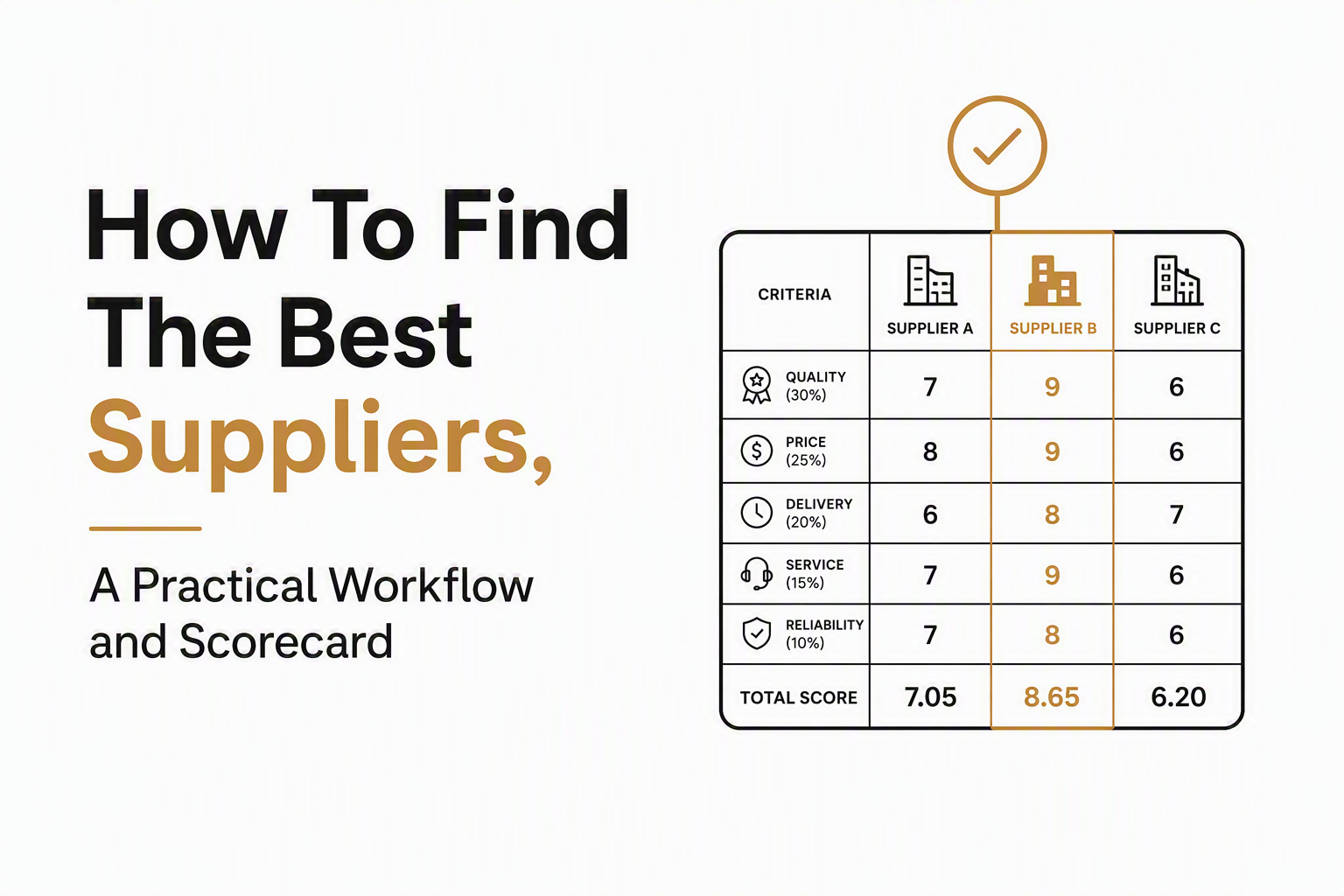
A weighted scorecard is the most practical way to compare suppliers objectively, because it turns mismatched pros and cons into a single decision record you can revisit later.
Stage 1 checklist: Choose 6 to 8 scoring categories that match your goal
- Product fit: can they build or source exactly what you sell, with clear specs?
- Quality capability: documented QC steps, willingness to agree on acceptance criteria, track record signals.
- Commercials: unit price, tooling, MOQs, payment terms, and realistic margin after landed costs.
- Lead time and capacity: normal lead time, peak constraints, ability to scale.
- Export readiness: documentation quality, packaging competence, and experience shipping to your market.
- Communication: response times, clarity, and ability to handle change control.
- Risk: identity confidence, subcontracting exposure, and red flags found in vetting.
Stage 2 checklist: Assign weights that reflect your business model
Weights should reflect what breaks your business. A reseller often weights lead time and MOQ higher; a private-label brand often weights quality and process control higher.
- Start with 100 total points distributed across categories.
- Set non-negotiables as gates: if the supplier fails a gate, they do not get scored (example gates: cannot confirm legal identity, refuses samples, cannot meet material requirement).
- Define what “1 to 5” means for each category to reduce bias (example: “5 = evidence-backed export experience to our market,” “1 = claims only”).
Stage 3 checklist: Score 3 suppliers side by side (worked example)
Below is a lightweight example you can copy. Replace weights and definitions with your own.
| Category | Weight | Supplier A (1-5) | Supplier B (1-5) | Supplier C (1-5) | Scoring notes (evidence) |
|---|---|---|---|---|---|
| Product fit | 20 | 4 | 5 | 3 | Catalog alignment, photos, sample feasibility |
| Quality capability | 20 | 3 | 4 | 2 | QC plan shared, inspection criteria agreement |
| Commercials | 20 | 5 | 3 | 4 | Quote completeness, MOQ, payment terms |
| Lead time and capacity | 15 | 3 | 4 | 3 | Standard lead time stated, peak plan explained |
| Export readiness | 10 | 4 | 4 | 2 | Document samples, packaging specs, Incoterms clarity |
| Communication | 10 | 4 | 3 | 2 | Response time, answers to technical questions |
| Risk (vetting) | 5 | 4 | 3 | 1 | Identity checks, web consistency, red flags |
Stage 4 checklist: Convert scores into a decision you can defend
- Write 3 evidence bullets per supplier explaining why they earned their score (links to documents, screenshots, shipment signals, sample results).
- Run a sensitivity check: if you change one weight (for example, Quality from 20 to 30), does the winner change? If yes, revisit your goal definition.
- Make the decision rule explicit: “Choose top score unless a gate fails after sampling” or “Choose top 2 for dual sourcing.”
What surprised our team was how often a “cheap” supplier lost after we scored total cost drivers and risk in the same model. A simple scorecard tends to surface hidden costs like rework, delays, and unclear packaging requirements.
RFQs, Samples, and Negotiation Basics Without Overpaying
RFQs and samples are the fastest way to prove capability and price realism, as long as you standardize what you ask for and what you measure.
Stage 1 checklist: Send an RFQ that forces apples-to-apples quotes
- Product spec pack: drawing or photo references, dimensions, materials, finish, packaging, labeling, and target compliance needs for your market.
- Order structure: request pricing at 2 to 3 quantity breaks (example: trial, first production, reorder). This helps you see MOQ pressure.
- Incoterms and destination: specify the term you want quoted (EXW, FOB, etc.) and the destination port or address.
- Timeline questions: production lead time, sample lead time, and peak season constraints.
- Quote completeness check: ask them to list what is excluded (tooling, packaging upgrades, inspection, documentation fees). Confirm directly: that the quote includes the packaging you will actually ship.
Stage 2 checklist: Evaluate samples like a repeatable test, not a vibe
- Define pass-fail criteria before the sample arrives (dimensions, finish consistency, assembly fit, weight, packaging survival criteria).
- Record defects with photos and counts, and tie them to specific requirements (so you can negotiate corrective action).
- Run a packaging drop or compression check that matches your fulfillment reality. If you ship parcel, test for parcel handling; if palletized, test stacking and corner protection.
- Change control: if you request a revision, require a new sample or signed spec acknowledgement. Confirm directly: which revision becomes the “golden sample.”
Stage 3 checklist: Negotiate without eroding quality
- Negotiate on structure, not only unit price: MOQ flexibility, packaging standardization, payment milestones, and rework responsibilities often beat a small price cut.
- Protect your reseller margin: compute estimated landed cost, marketplace fees, returns allowance, and warranty reserve before you accept a “good” unit price.
- Payment term realism: new relationships often start with deposit and balance; mitigate risk with documentation, inspections, and staged approvals rather than arguing for terms the supplier cannot accept.
For a deeper step-by-step checklist for first orders, this guide on how to find a supplier for your product pairs well with the scorecard approach above.
How to Monitor Supplier Performance After You Choose
Supplier monitoring keeps you from having to “re-find” the best supplier every quarter, because performance drift usually shows up in a few measurable indicators first.
Stage 1 checklist: Set 5 to 7 KPIs you can actually track
- On-time delivery: promised ship date vs actual ship date.
- Lead time stability: average lead time and variance over the last 3 to 6 orders.
- Defect rate: defects per batch or per inspection lot, categorized by severity.
- Return and complaint rate: the downstream signal resellers see first.
- Responsiveness: average time to first response and time to resolution on issues.
- Change adherence: how often changes are shipped incorrectly after a revision is agreed.
Stage 2 checklist: Build a simple review cadence
- Every order: record promised dates, actual dates, inspection results, and issue tickets in one place.
- Monthly: trend KPIs and document top recurring defects and root causes.
- Quarterly: re-score the supplier on the same weighted scorecard categories, then decide: keep, improve plan, or add a backup.
Stage 3 checklist: Define corrective action triggers
- Trigger thresholds: decide what causes escalation (example: repeated late deliveries, repeated critical defects, or repeated documentation errors).
- Corrective action format: require a short plan with cause, fix, owner, and deadline. Confirm directly: that the supplier understands the updated spec and inspection criteria.
- Dual sourcing rule: if a product is business-critical, keep a qualified backup supplier warm with periodic small orders or sample refreshes.
After running supplier reviews across multiple quarters, the pattern was clear: the strongest suppliers are not the ones that never have issues, but the ones that close the loop fast with documented fixes and fewer repeat defects.
If you want more context on why this matters, this explainer on the purpose of supplier evaluation connects monitoring to cost, risk, and long-term reliability.
FAQ about finding and evaluating suppliers
If you are building your workflow for Vietnam sourcing, Ant Sourcing can help you centralize discovery, verification documents, and ongoing quality control tracking so your team can apply the same checklist and scorecard each time. You can also pull your scorecard into a shared process and keep supplier research as reusable team knowledge. For a broader overview, see our guide to research suppliers.
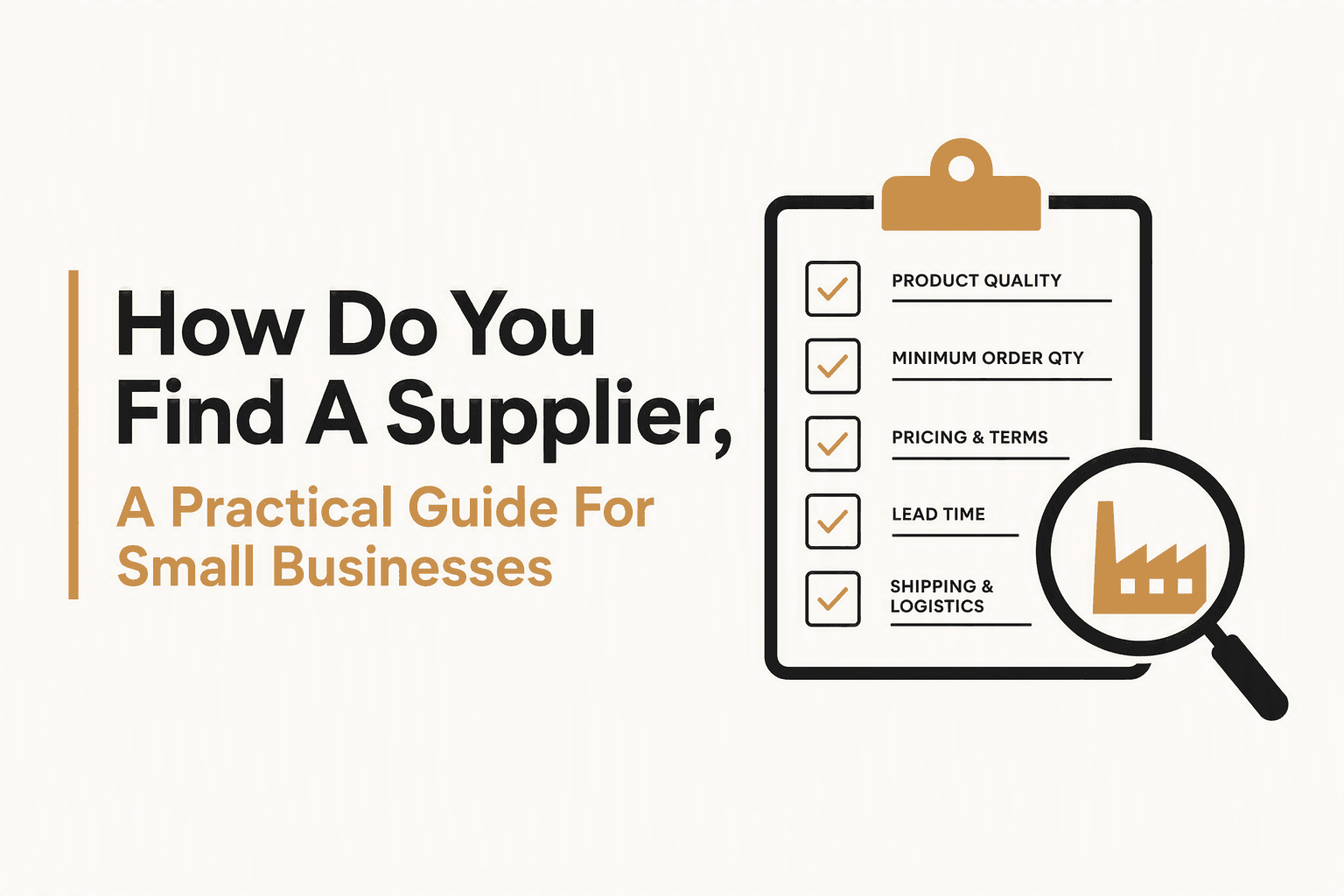
How Do You Find A Supplier, A Practical Guide For Small Businesses
Learn how do you find a supplier with a simple SOP: set requirements, search channels, email RFQs, compare quotes, verify, and place your first order.
Purpose Of Supplier Evaluation Explained, The 5 Reasons It Matters
Learn the purpose of supplier evaluation, how it works in sourcing, and how to build a simple scorecard with weighted criteria for better decisions.
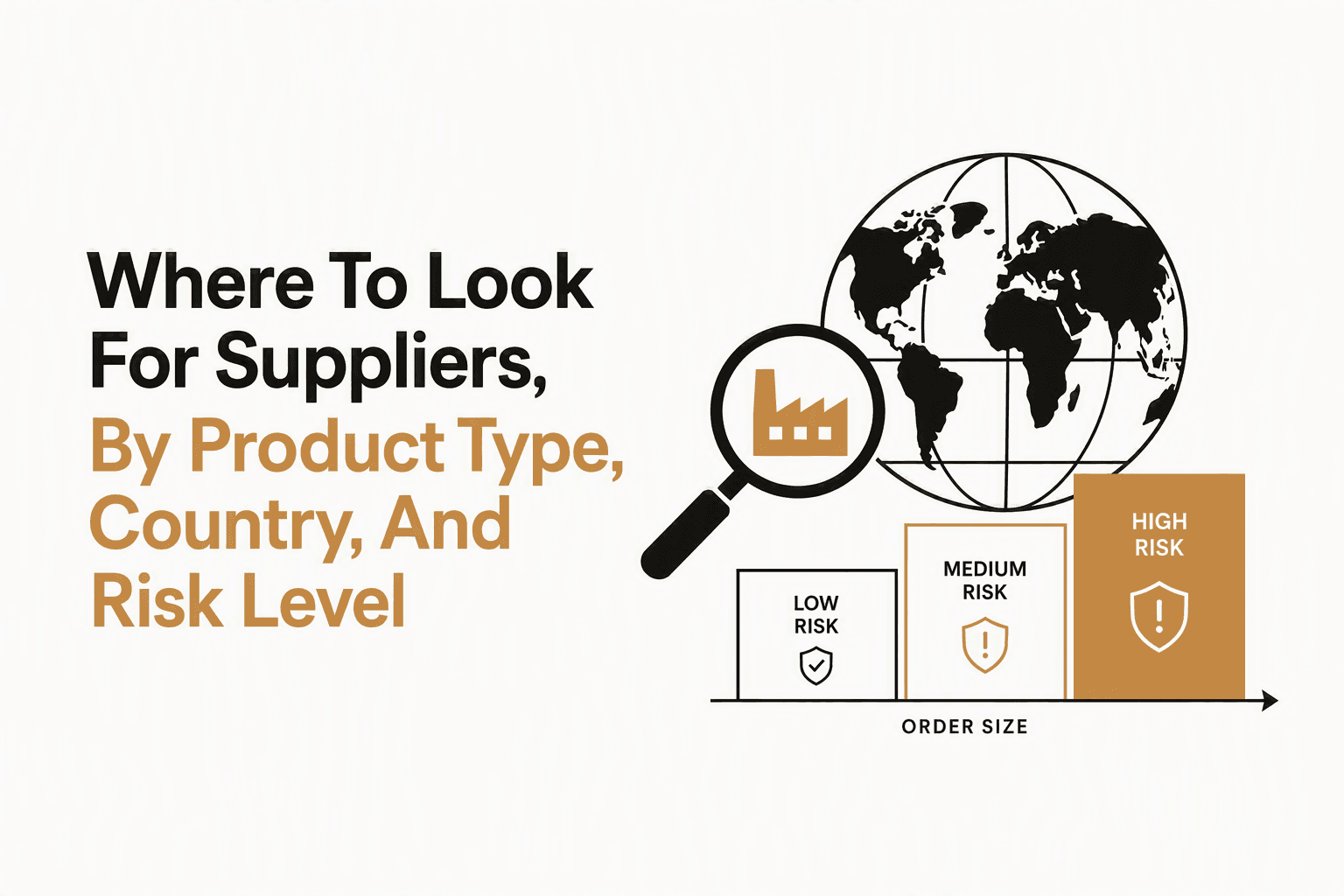
Where To Look For Suppliers, By Product Type, Country, And Risk Level
Learn where to look for suppliers by product type, country, and risk level, plus a practical checklist to research and shortlist partners fast.