
Where To Look For Suppliers, By Product Type, Country, And Risk Level
Where to look for suppliers depends on the supplier type you need, the product category, your order size, and the amount of risk you can tolerate, so this guide maps the best channels and gives a usable research checklist before you request quotes.
- Pick the right channel by scenario: custom manufacturing, branded resale, commodity sourcing, or low-risk replenishment all require different supplier sources.
- Use a repeatable workflow: search with operator patterns, validate legitimacy quickly, then compare quotes, samples, MOQ, and lead times with the same scorecard.
- Confirm the highest-risk info directly with the supplier: factory ownership, capacity, QC process, lead times, and payment terms.
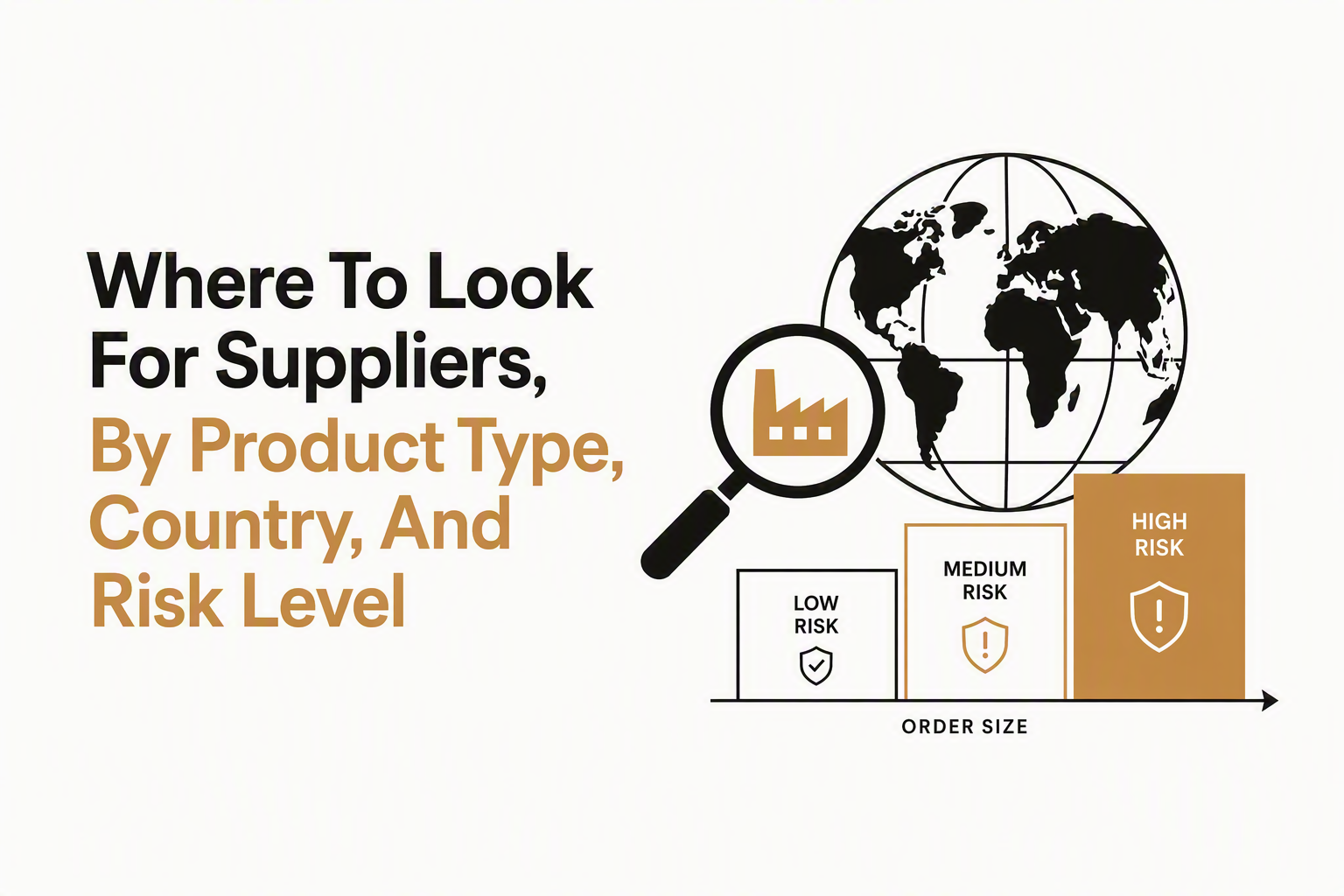
Start By Defining The Supplier Type You Actually Need
Where to look for suppliers becomes much easier once you choose the supplier type based on the outcome you want: custom production, branded resale, bulk distribution, or hands-off fulfillment.
Stage 1 checklist: classify the supplier before you search
- Write your target relationship in one line. Examples: “OEM manufacturer for our design,” “authorized distributor for Brand X,” “wholesaler for fast replenishment,” “dropshipper for testing demand.”
- Decide whether you need factory control or inventory access. Manufacturers give process control; wholesalers and distributors give speed and smaller buys.
- Set your non-negotiables. List: target country, required materials, compliance needs (only if truly required), target landed cost range, and earliest ship date.
Plain-language definitions (and what they imply)
- Manufacturer: Makes the product. Best for custom specs, private label, and cost down work. Tradeoff: more work validating QC and capability.
- Wholesaler: Buys in bulk and resells from inventory. Best for speed, smaller MOQs, and multi-brand catalogs. Tradeoff: less customization and thinner margin control.
- Distributor (authorized or independent): Sells a brand’s products into a region, sometimes exclusively. Best when you need brand legitimacy and stable supply. Tradeoff: pricing and territory constraints.
- Dropshipper: Ships to your customer on your behalf. Best for early product tests. Tradeoff: limited control over packing, QC, and stockouts.
Stage 1 pass fail questions (confirm directly with the supplier)
- Are you the manufacturer or a trading company? Ask for the factory address and business registration name.
- Do you hold inventory or produce to order? This determines lead time and MOQ reality.
- Can you share a recent production schedule snapshot? Even a redacted view helps you judge capacity claims.
- Who owns QC sign-off? Ask whether final inspection is internal QC, a third party, or customer required.
Match Supplier Sources To Product Type, Geography, And Order Size
Where to look for suppliers should be decided by scenario, because the best channel for custom furniture manufacturing is rarely the best channel for branded resale or commodity components.
Stage 2 checklist: pick your source channel using a simple scenario map
- Choose your product risk profile: low (commodity, simple specs), medium (multiple materials, moderate tolerances), high (regulated, safety critical, complex assemblies).
- Choose your order mode: test order, replenishment, or scale order.
- Choose your geography strategy: domestic only, nearshore, or offshore with QC controls.
Scenario map: which channels usually fit best
- Custom OEM or private label: factories found via trade fairs, industry associations, verified industrial directories, and shipment or trade-activity research where available.
- Branded products (resale): brand “Where to buy” pages, authorized distributor lists, and direct confirmation from the brand’s channel team.
- Commodity parts and materials: industrial directories, local importers, and specialist hubs by category (for example, hardware, textiles, packaging).
- Fast replenishment in small lots: wholesalers, local distributors, and domestic reps.
- Demand tests: vetted dropship programs and domestic wholesalers with clear return and defect handling.
Operational criteria to choose a channel (not just convenience)
- Traceability: Can you verify who actually makes the product, not just who lists it?
- Comparable references: Can the supplier point to customers with similar product complexity and order size?
- Specification control: Can you lock materials, tolerances, packaging, labeling, and QC checkpoints?
- Commercial leverage: Can you negotiate MOQ, incoterms, and payment milestones at your current volume?
In our experience working with first-time importers, the biggest early mistake is defaulting to the most visible marketplace listing rather than choosing the channel that makes verification easiest for their risk level.
Use Search Operators And Keyword Swaps To Find Better Suppliers
Where to look for suppliers on Google becomes more productive when you search like an auditor, using operator patterns and keyword swaps that surface factories, associations, and credible directories instead of thin broker pages.
Stage 3 checklist: a repeatable Google workflow
- Start with 3 keyword sets:
- Product: “oak dining chair”, “rubberwood cabinet”, “metal furniture legs”.
- Industry term: “manufacturer”, “factory”, “OEM”, “ODM”, “industrial park”.
- Geography: country, province/state, or manufacturing cluster city.
- Run 4 operator searches and save results into a shortlist sheet:
- Site filtering:
site:.govorsite:.org+ your product + “members” (find associations and member lists). - Document trail:
filetype:pdf+ your product + “exhibitor list” (find trade fair exhibitor PDFs). - Title targeting:
intitle:manufacturer+ product + country (find pages that self-identify clearly). - Exclude noisy results: add
-retail -amazon -etsy -alibabawhen you want independent sites.
- Site filtering:
- Swap “manufacturer” with local or category synonyms: Examples: “industrial”, “fabrication”, “mill”, “workshop”, “plant”, “contract manufacturing”.
- Validate each result with a quick triangulation: check address consistency, product photos matching capability, and a traceable business name.
What to capture in your shortlist sheet (minimum viable data)
- Legal entity name (as written on registration, invoice, or export docs).
- Factory or warehouse address (not only a city name).
- Product scope (specific SKUs or categories, not “we make everything”).
- Proof of activity (recent catalog date, trade fair exhibitor listing, or other verifiable footprint).
- Initial risk notes (free email domain, mismatched address, copied photos, unclear legal name).
Two quick example queries you can copy
"dining chair" intitle:factory Vietnam rubberwood -retail -amazon"furniture" filetype:pdf "exhibitor list" "Ho Chi Minh"
Where To Look For Suppliers In The US
Where to look for suppliers in the US is usually a mix of industrial directories, regional manufacturing networks, trade shows, and location-based searches that prioritize transparency and short lead times.
Stage 4 checklist: US-specific channels to try in order
- Industrial directories with verifiable company profiles. Look for listings that include NAICS category alignment, addresses, and contact roles.
- Regional manufacturing associations and member rosters. Many associations publish member directories where the “member since” and location are visible.
- Trade shows and exhibitor lists. Even if you do not attend, exhibitor PDFs give you company names mapped to categories.
- Local cluster searches. Combine product + city/state + “manufacturer” and “contract manufacturing”. Many specialty shops are not marketplace active but have stable B2B work.
- Port and logistics adjacency searches for importers. For distribution partners, search near major logistics hubs where inventory-based sellers operate.
Location-based search pattern (simple but effective)
- Query template:
[product] + [state] + (manufacturer OR fabrication OR contract) - Then refine by capability terms: “CNC”, “powder coating”, “kiln dried”, “upholstery”, “assembly”. Only use terms relevant to your product.
- Confirm the address and facility type: a real industrial address beats a virtual suite when you need manufacturing.
What surprised our team was how often the best US options were found through exhibitor lists and regional networks rather than general “supplier directory” pages, because the former tend to include traceable company details you can verify quickly.
How To Trace Authorized Suppliers For Big Brands
Where to look for suppliers for branded goods should start with authorization tracing, because the lowest-risk path is confirming that the seller is approved by the brand for your region and channel.
Stage 5 checklist: confirm authorization before outreach
- Start at the brand’s official channel pages. Look for “Where to buy,” “Distributors,” “Dealers,” or “Authorized partners.”
- Match the legal entity name. “Trading as” names can hide who you are really buying from; ask for the invoice entity upfront.
- Ask for written confirmation you can verify. Request an authorization letter or partner certificate and confirm its validity with the brand (not only the distributor).
- Check territory and channel restrictions. Some distributors can sell only within a geography or only into certain customer segments.
Red flags specific to “authorized” claims (confirm directly with the supplier)
- Authorization cannot be verified by the brand. If the brand will not confirm, treat the claim as unproven.
- Mismatch between website name and invoice name. This can be legitimate but should be explained and documented.
- Unusually large discounts on controlled brands. This may signal gray market supply, expired stock, or non-authorized channels.
Run A Fast Legitimacy Check Before You Request Quotes
Where to look for suppliers is only half the job, because a fast legitimacy check filters out high-risk entities before you invest time in RFQs, samples, and negotiations.
Stage 6 pass fail checklist: legitimacy in 20 minutes
- Business identity check:
- Does the supplier provide a legal company name that matches their documents and website?
- Does the address look like a plausible factory or warehouse location for the product?
- Do phone numbers and emails look consistent with the company name (avoid relying on only web forms)?
- Capability evidence check:
- Can they show recent, detailed product photos from production, not only studio images?
- Can they describe materials and process steps without vague phrasing?
- Can they share sample policy and realistic timelines?
- Commercial risk check:
- Do the proposed payment terms fit your risk tolerance (for example, deposit plus balance after inspection or before shipment)?
- Do they accept secure payment methods appropriate for B2B trade?
- Do they pressure you to pay quickly without specs being finalized?
- Reference check:
- Can they provide customer references relevant to your category and order size?
- Can they provide trade documentation examples (redacted) that show exporting experience if you are importing?
What to confirm directly with the supplier before sending an RFQ
- Incoterms and port of loading (so quotes are comparable).
- Whether they are a manufacturer, trading company, or both for your specific SKU.
- Quality checkpoints they will follow and what evidence they can provide (inspection reports, photos, test results where applicable).
- Change control process for materials or sub-suppliers if shortages happen.
Compare Quotes, Samples, MOQ, And Lead Times Before You Shortlist
Where to look for suppliers ultimately matters less than how you compare them, so use the same scorecard to evaluate quotes, samples, MOQ, and lead times before you decide who is safest to contact first.
Stage 7 checklist: standardize what you ask for so quotes are comparable
- Send a one-page RFQ spec. Include material, finish, dimensions, packaging, labeling, and expected order cadence.
- Request tiered pricing. Ask for pricing at 3 volumes (test, mid, scale). This reveals real MOQ flexibility.
- Request lead time split. Ask for sample lead time, first production lead time, and repeat order lead time.
- Define defect handling upfront. Ask how they handle DOA, cosmetic defects, and in-transit damage, and what evidence is needed.
Stage 7 checklist: evaluate samples like a QC gate
- Visual and build checklist. Confirm finish consistency, joints, alignment, packaging integrity, and labeling accuracy.
- Material confirmation. Ask for the exact material spec used in the sample, and whether substitutes are ever used.
- Repeatability test. If the product is sensitive, order 2 samples or request a small pilot to see consistency.
Final review: a simple decision rubric (lowest risk first)
- Shortlist 2 to 3 suppliers only after they pass legitimacy and sample checks.
- Score each supplier 1 to 5 on: (1) verification strength, (2) product capability proof, (3) quote clarity, (4) lead time realism, (5) communication quality.
- Choose the first supplier to proceed with based on total score, then break ties using your biggest constraint (time, MOQ, or spec complexity).
After running many early-stage supplier shortlists, the pattern was clear: the supplier with the clearest assumptions and the most verifiable evidence usually wins, even if their unit price is not the absolute lowest.
| Channel | Best for | Main risk | What to verify first |
|---|---|---|---|
| Trade shows / exhibitor lists | Manufacturers with category focus | Marketing claims vs real capacity | Factory address, product photos from production, sample policy |
| Industry associations | Domestic or regional suppliers with traceability | Member listing does not equal capability | Relevant past work, process steps, lead times |
| Industrial directories | Broad discovery across categories | Outdated profiles or intermediaries | Legal entity, address consistency, exporting experience |
| Brand authorized lists | Branded resale with lower channel risk | Gray market sellers posing as authorized | Authorization confirmation from the brand, territory rights |
| Wholesalers | Fast replenishment, smaller MOQs | Limited customization, variable stock | Inventory availability, return policy, defect handling |
FAQ
If your shortlist includes Vietnam-based manufacturers and you want a structured way to research suppliers and add quality control checks before you commit, Ant Sourcing can be a helpful next step after you have narrowed options to a manageable few.
How To Find The Best Suppliers, A Practical Workflow and Scorecard
Learn how to find the best suppliers using a repeatable checklist, vetting steps, and a simple weighted scorecard for objective comparison.
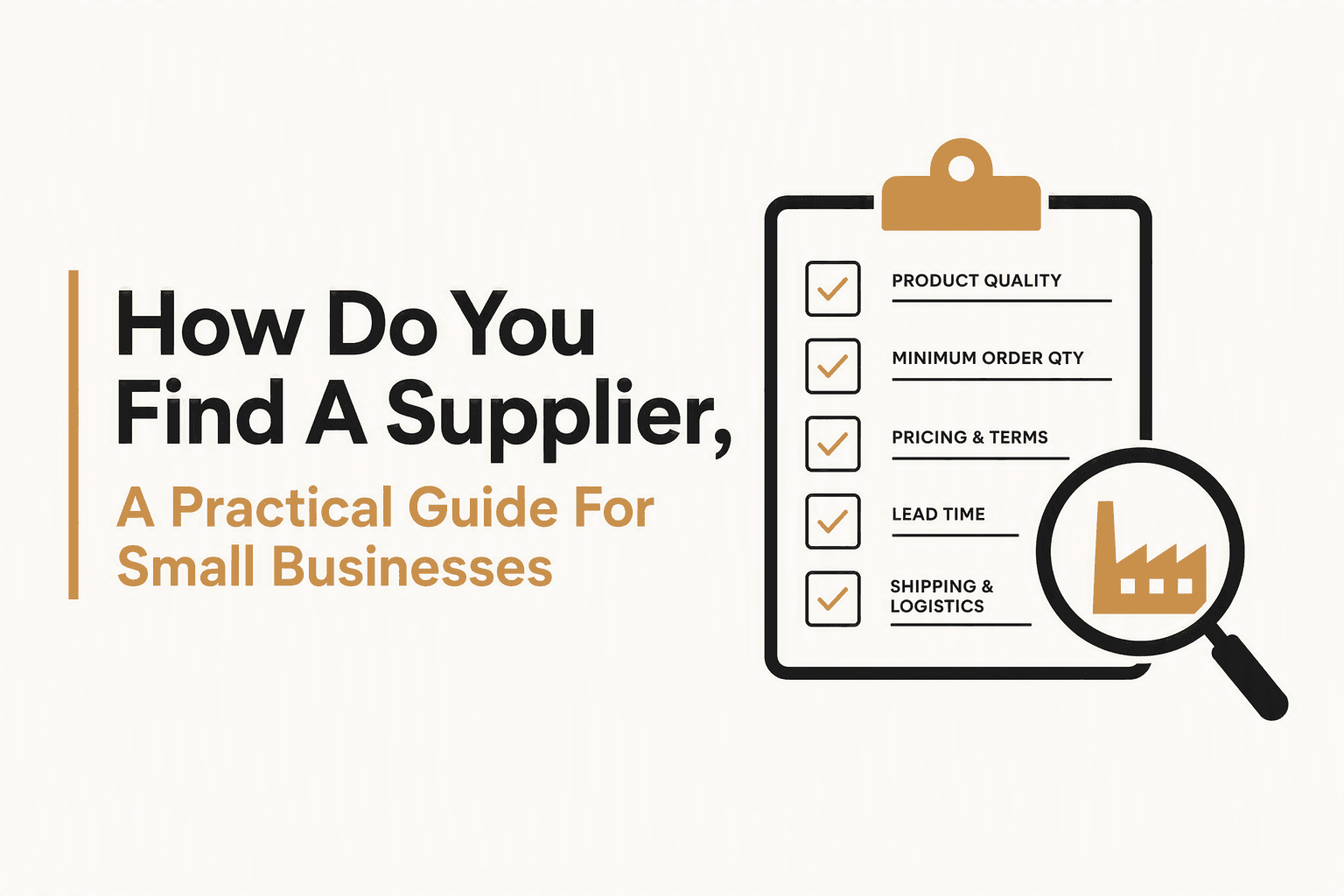
How Do You Find A Supplier, A Practical Guide For Small Businesses
Learn how do you find a supplier with a simple SOP: set requirements, search channels, email RFQs, compare quotes, verify, and place your first order.
Purpose Of Supplier Evaluation Explained, The 5 Reasons It Matters
Learn the purpose of supplier evaluation, how it works in sourcing, and how to build a simple scorecard with weighted criteria for better decisions.