
How To Find A Supplier For Your Product, A Step-By-Step Sourcing Checklist
How to find a supplier for your product comes down to running a repeatable evaluation workflow: define specs and constraints, build a shortlist, screen fast, verify capability and quality, then compare quotes and control risk on the first PO.
- Start with a written product spec, volume forecast, and constraints so you can screen suppliers objectively, not emotionally.
- Use a two-pass qualification: fast screen (red flags and proof) then deep verification (sample, audit evidence, and QA plan).
- Compare quotes with an apples-to-apples RFQ and a scoring matrix that prices in lead time, payment risk, and quality controls.
Start With What You’re Actually Buying, Specs, Volumes, And Constraints
How to find a supplier for your product starts with a spec pack that makes supplier fit measurable and prevents “yes to everything” sales replies from wasting weeks.
Stage 1 checklist: Build a one-page spec pack (minimum viable)
- Product definition: SKU name, intended use, target customer, and the problem it solves.
- Drawings or reference: CAD, annotated photo, or a competitor sample. If none exist, add a hand sketch plus dimensions.
- Critical-to-quality (CTQ) list: 5 to 10 must-pass requirements (example: overall dimensions, load rating, surface finish, color match tolerance, key functional features).
- Materials and components: list what is required vs acceptable alternatives (example: “acacia wood acceptable; no MDF on visible faces”).
- Packaging requirements: carton type, drop test expectation if you have one, labeling, barcodes, inserts, and palletization needs.
- Target order volumes: pilot quantity (first PO) and a 6 to 12 month forecast range.
- Target cost and should-cost boundaries: a target is fine, but also set a “walk-away” price that fails your margin.
- Timeline constraints: required ship date window, and any seasonality.
Stage 2 checklist: Define your “non-negotiables” before talking to suppliers
- Compliance constraints (confirm with supplier): country specific requirements that apply to your category and market. If you are unsure, write “market compliance required” and validate later with your compliance advisor.
- Quality acceptance rule: define pass/fail for each CTQ (example: “dimension must be within drawing spec”; “finish must be free of scratches visible at 60 cm”).
- Commercial boundaries: maximum deposit you will pay, preferred Incoterm, and whether you will allow MOQs above your pilot plan.
Quick tool: The “3 numbers” that keep sourcing grounded
- Pilot quantity: the smallest order that still tests the real production process, not just a handmade sample.
- Target landed cost: product cost plus freight, duty, and packaging, so quote comparisons stay realistic.
- Required lead time window: latest acceptable ship date, not just the supplier’s stated lead time.
Where To Find Potential Suppliers, Channels That Match Your Product Type
How to find a supplier for your product becomes faster when you choose sourcing channels that match your product complexity, risk tolerance, and the kind of proof you need.
Stage 3 checklist: Choose channels by use case (not popularity)
- Online supplier directories: best for building a wide shortlist quickly, then filtering hard with documentation. Use when you can clearly specify CTQs and don’t need heavy co-development.
- Trade shows: best for seeing build quality in person and comparing multiple factories in one day. Use when finish, materials, or construction are hard to judge from photos.
- Referrals from industry peers: best for speed and lower scam risk, but still verify capability for your exact SKU.
- Local sourcing agents or consultants: best when you need language support, factory visits, or negotiation help, especially for first-time importing.
- Direct outreach to manufacturers (by product clues): best when you already know what “good” looks like, and you can identify similar export products.
What to capture for every lead (so you can compare later)
- Company identity: legal name, address, website, and the email domain used.
- Product evidence: links, catalogs, photos, and any model numbers that resemble your product.
- Export evidence: markets served, typical customers (if shared), and whether they ship to your region.
- Process clues: mentions of materials, machinery, finishing methods, or assembly lines relevant to your CTQs.
Experience note (what changes the hit rate)
In our experience working with early-stage buyers, the shortlist quality improves when the first outreach is limited to 15 to 25 suppliers that already show similar products, rather than blasting 200 generic inquiries.
If you want a deeper framework that complements this checklist, see how to look for suppliers and how to find suppliers for products.
How To Screen Suppliers Fast, A Qualification Checklist Before You Email Back
How to find a supplier for your product without losing weeks requires a two-pass screen: first eliminate obvious mismatch and risk, then request only the minimum proof needed to justify a sample.
Stage 4 checklist: 10-minute “fast screen” (before any meeting)
- Product match: do they show your product category and similar construction, not just “we can make anything”?
- Communication quality: do they answer the specific CTQs you listed, or do they reply with generic brochures?
- Consistency signals: company name matches email domain, website, and documents. Mismatches are a risk flag.
- Quote realism: prices far below your target with no explanation often indicate bait-and-switch or quality downgrades.
- Lead time plausibility: extremely short lead times for complex goods are usually not real production promises.
Stage 5 checklist: Minimum documentation to request (confirm directly with supplier)
- Factory profile: legal entity name, address, year established, and whether they are a manufacturer or trading company.
- Product capability proof: photos of similar products from their own line, not stock images; basic process description (example: “solid wood machining + sanding + finishing”).
- Quality workflow overview: where they check CTQs (incoming materials, in-process, final).
- Export references: markets shipped to and whether they can share non-confidential references (even if anonymized).
- Sampling plan: sample cost, sample lead time, and what the sample represents (handmade vs production line).
Red flags that are operational, not emotional
- Refusal to share basics: unwilling to provide a legal name, address, or clear scope of work.
- Pressure on payment: insistence on full prepayment for a first order without offering risk controls (inspection, milestones, or escrow alternatives where appropriate).
- Shifting stories: changing capacity claims, changing factory location, or inconsistent answers between emails and calls.
How To Verify A Supplier Can Deliver Quality And On-Time, Before A Purchase Order
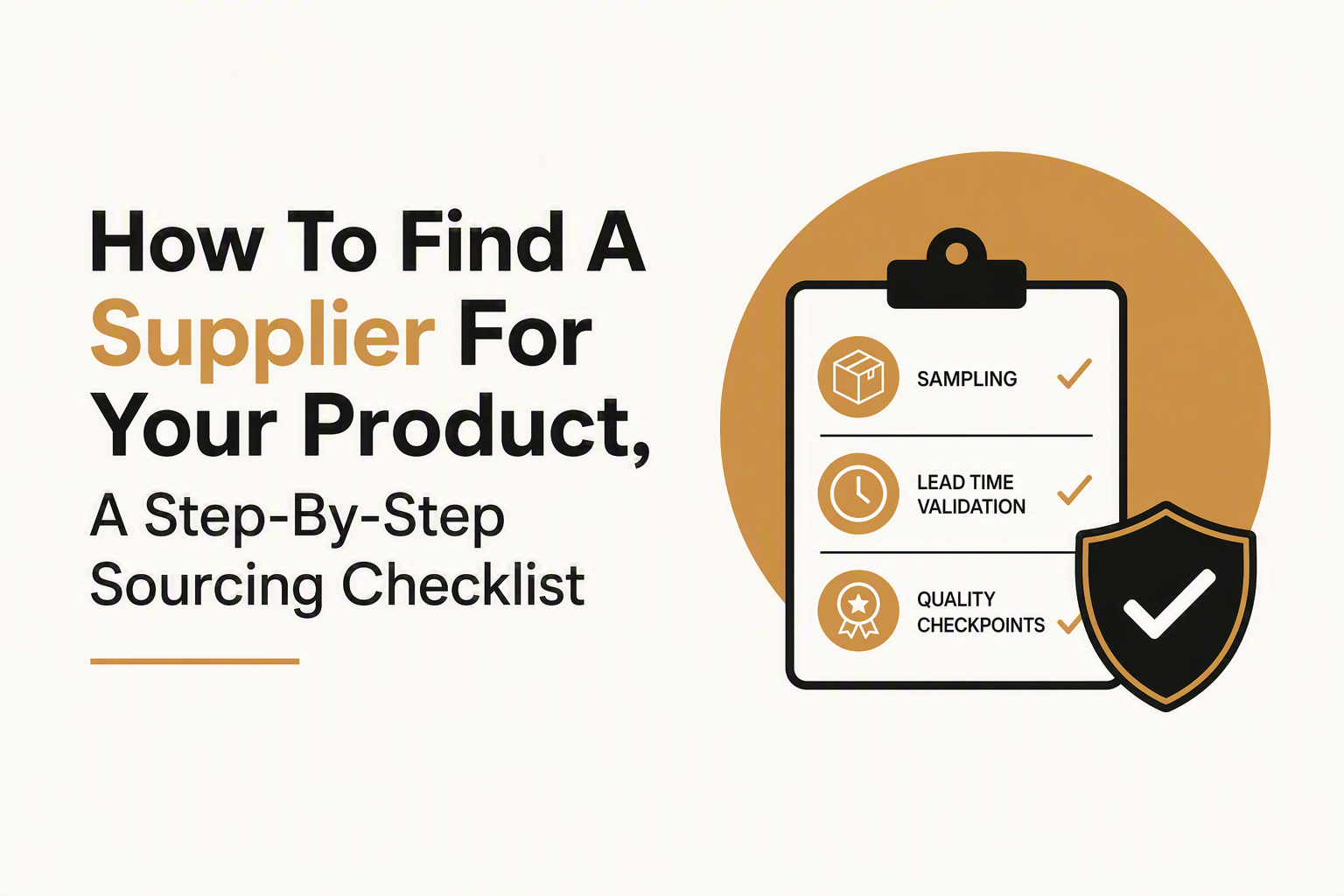
How to find a supplier for your product safely depends on verification steps that force reality checks on quality, capacity, and lead time before you commit to production.
Stage 6 checklist: Sampling that actually de-risks production
- Define what the sample is: require the supplier to state whether the sample is handmade or produced using intended tooling and line processes (confirm directly with supplier).
- Sample evaluation worksheet: measure each CTQ, record actual values, and photograph defects using the same lighting and angles each time.
- Change log: every change request must be tracked with version numbers so you do not approve “Sample A” and receive “Production B”.
- Pilot run trigger: if the product has complex finishing, tight tolerances, or multiple sub-suppliers, require a small pilot run before scaling.
Stage 7 checklist: Lead time validation (what to ask for)
- Critical path breakdown: raw material procurement time, tooling time (if any), production time, finishing/curing time, packing time.
- Capacity evidence: number of lines or shifts relevant to your product type, and what else is running in the same period (confirm directly with supplier).
- Buffer rule: add your own buffer for first POs because first-run issues, rework, and packaging corrections are common.
Stage 8 checklist: Quality assurance plan (simple but enforceable)
- CTQ control points: specify where each CTQ is checked (incoming, in-process, final).
- Defect classification: agree on what counts as a critical, major, or minor defect for your product. If you do not have definitions, at least define “must reject” vs “acceptable with rework”.
- Inspection milestones: pre-production confirmation, during-production check, and pre-shipment inspection. Confirm timing windows and who pays if a re-inspection is needed (confirm directly with supplier).
What surprised our team was how often “on-time” failures trace back to packaging and labeling changes made after production starts, so we now lock packaging artwork and carton specs before greenlighting mass production.
How To Request Quotes And Compare Them Correctly, Not Just By Lowest Price
How to find a supplier for your product and choose the right one requires quote comparisons that control for scope, assumptions, and risk, not just unit price.
Stage 9 checklist: RFQ structure (send the same template to all suppliers)
- Product spec pack attached: drawing, photos, CTQs, and packaging requirements.
- Quote quantities: ask for 3 tiers (example: pilot, mid, scale) so you see how pricing behaves with volume.
- Incoterm and destination: clarify whether you want EXW, FOB, etc., and the named port or location.
- Tooling and setup costs: ask them to separate one-time costs from recurring unit costs.
- Lead time breakdown: sample lead time and production lead time, plus assumptions.
- Payment terms requested: state your preferred structure and ask alternatives (confirm directly with supplier).
- Validity window: how long the quote is valid and what drives price changes (materials, exchange rates).
Stage 10 checklist: Compare quotes apples-to-apples
- Scope check: confirm all suppliers priced the same materials, packaging, included parts, and workmanship level.
- Assumption log: write down any hidden assumptions (example: “price assumes rubberwood, not oak”).
- Risk pricing: treat unclear lead time, vague QC, or limited export experience as a cost, because it shows up later as rework, delays, or chargebacks.
Simple scoring matrix you can reuse
- Cost (30%): unit price plus one-time costs, normalized to the same Incoterm.
- Quality confidence (30%): sample results vs CTQs, clarity of QA plan, willingness to document.
- Delivery confidence (20%): lead time breakdown, capacity evidence, responsiveness.
- Commercial terms (20%): payment structure, warranty/returns handling, willingness to support inspections.
First Order Playbook, Contracts, Payment Terms, And Quality Control Milestones
How to find a supplier for your product is only complete when the first PO is structured to catch problems early through written specs, staged approvals, and clear acceptance rules.
Stage 11 checklist: What your first PO must include
- Version-controlled spec reference: PO references drawing/spec version numbers and approved sample version.
- Packaging and labeling annex: carton spec, labels, barcodes, and required marks.
- Acceptance criteria: CTQs and what happens if goods fail inspection (rework, replacement, discount, or cancel terms). Confirm feasibility directly with supplier.
- Lead time and ship window: agreed ship date window and what constitutes a delay.
Stage 12 checklist: Payment terms and risk controls (confirm directly with supplier)
- Link payments to milestones: deposit, then balance after pre-shipment inspection pass or after corrective actions are completed.
- Avoid “all-risk up front” terms: if full prepayment is requested, require stronger safeguards (inspection rights, clear rework obligations, and documentary evidence).
- Bank detail verification: verify beneficiary name matches supplier legal name, and confirm changes via a second communication channel.
Stage 13 checklist: Milestones and escalation path
- Pre-production confirmation: sign off on materials, finish standard, and packaging before mass production.
- During-production check: verify first articles and in-process CTQs early enough to correct.
- Pre-shipment inspection: check count, workmanship, packaging, and CTQs against your worksheet.
- Escalation rule: define who decides rework vs ship vs cancel, and within what time window.
After running multiple supplier evaluations, the pattern was clear: the “best” first order is the one that forces early confirmations in writing, because ambiguity nearly always becomes a dispute when goods are already packed.
Final decision review (go/no-go)
- Go: sample meets CTQs, supplier documents are consistent, lead time is broken down credibly, and you have inspection milestones plus enforceable acceptance criteria.
- Conditional go: minor CTQ gaps with a written corrective plan and a pilot run, plus added inspection points.
- No-go: inconsistent identity, refusal to document, unrealistic lead times, or inability to explain how CTQs are controlled.
| Stage | Goal | Proof to collect | Decision output |
|---|---|---|---|
| Specs and constraints | Make supplier fit measurable | Spec pack, CTQs, volume tiers | Shortlist criteria |
| Channel selection | Find relevant suppliers faster | Comparable product evidence | 15 to 25 supplier shortlist |
| Fast screening | Remove mismatch and high risk | Identity consistency, basic docs | Sample candidates |
| Verification | Prove quality and delivery ability | Sample worksheet, QA plan, lead time breakdown | RFQ-ready suppliers |
| RFQ comparison | Choose best total value | Normalized quote + assumptions log | Preferred supplier + backup |
| First PO controls | Prevent first-run surprises | Milestones, inspections, acceptance criteria | Go/no-go and execution plan |
FAQ
If you are ready to operationalize this checklist in Vietnam, Ant Sourcing can help you research suppliers and coordinate verification and quality control workflows, so your team can make a go/no-go decision before committing to a first PO.
How To Find The Best Suppliers, A Practical Workflow and Scorecard
Learn how to find the best suppliers using a repeatable checklist, vetting steps, and a simple weighted scorecard for objective comparison.
How Do You Find A Supplier, A Practical Guide For Small Businesses
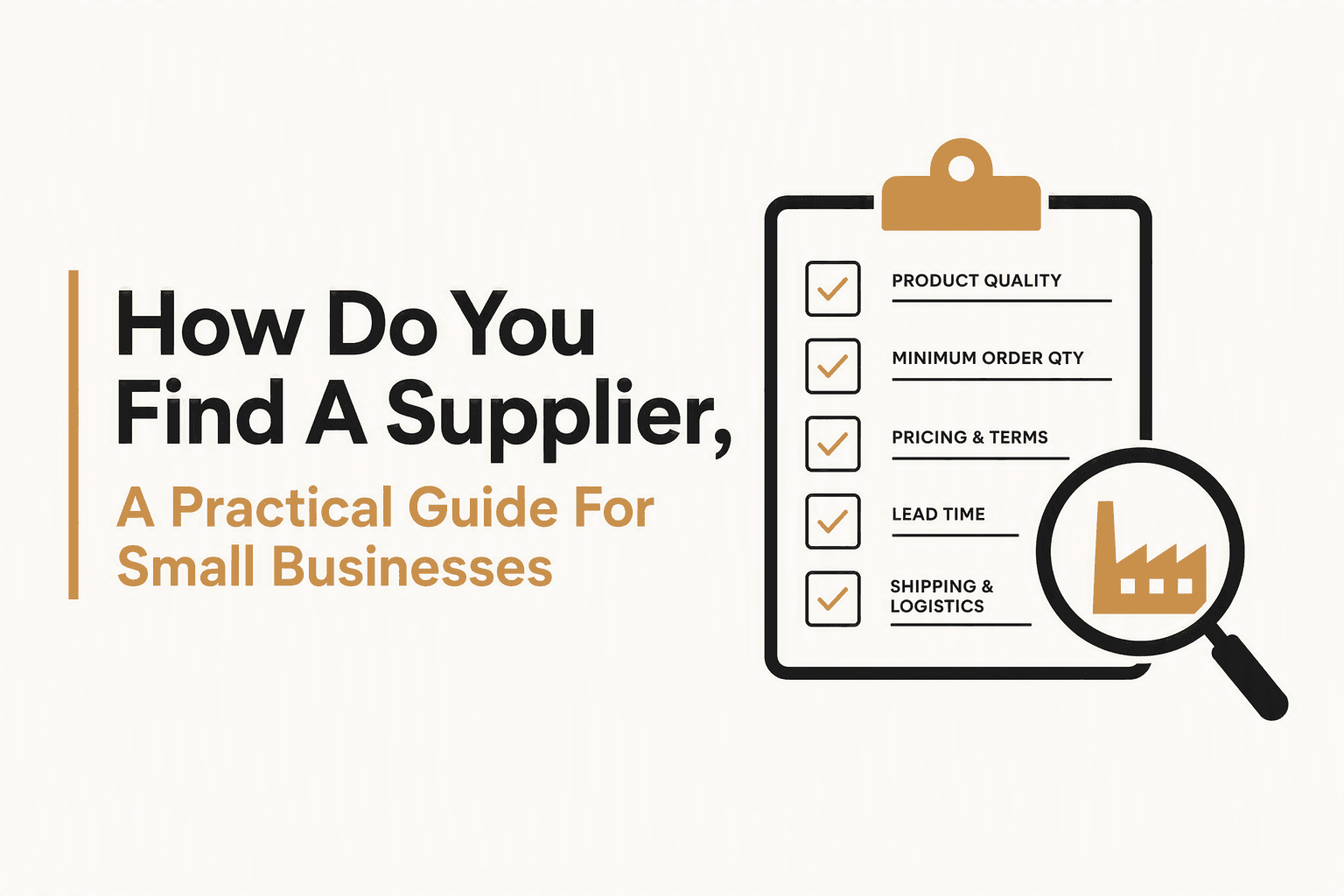
Learn how do you find a supplier with a simple SOP: set requirements, search channels, email RFQs, compare quotes, verify, and place your first order.
Purpose Of Supplier Evaluation Explained, The 5 Reasons It Matters
Learn the purpose of supplier evaluation, how it works in sourcing, and how to build a simple scorecard with weighted criteria for better decisions.