
How Do You Find A Supplier, A Practical Guide For Small Businesses
How do you find a supplier you can trust without wasting weeks on dead ends? Use a repeatable workflow: define requirements, search in the right channels, qualify supplier type, send a structured RFQ, compare on a scorecard, verify legitimacy, then start with a controlled first order.
- Write supplier requirements first (specs, MOQ, lead time, non negotiables) so you can filter fast and avoid mismatched quotes.
- Use a simple RFQ email plus a quote comparison scorecard to choose based on total risk and total cost, not unit price alone.
- Verify suppliers with document checks, trade activity signals, and sample validation before you send large deposits.
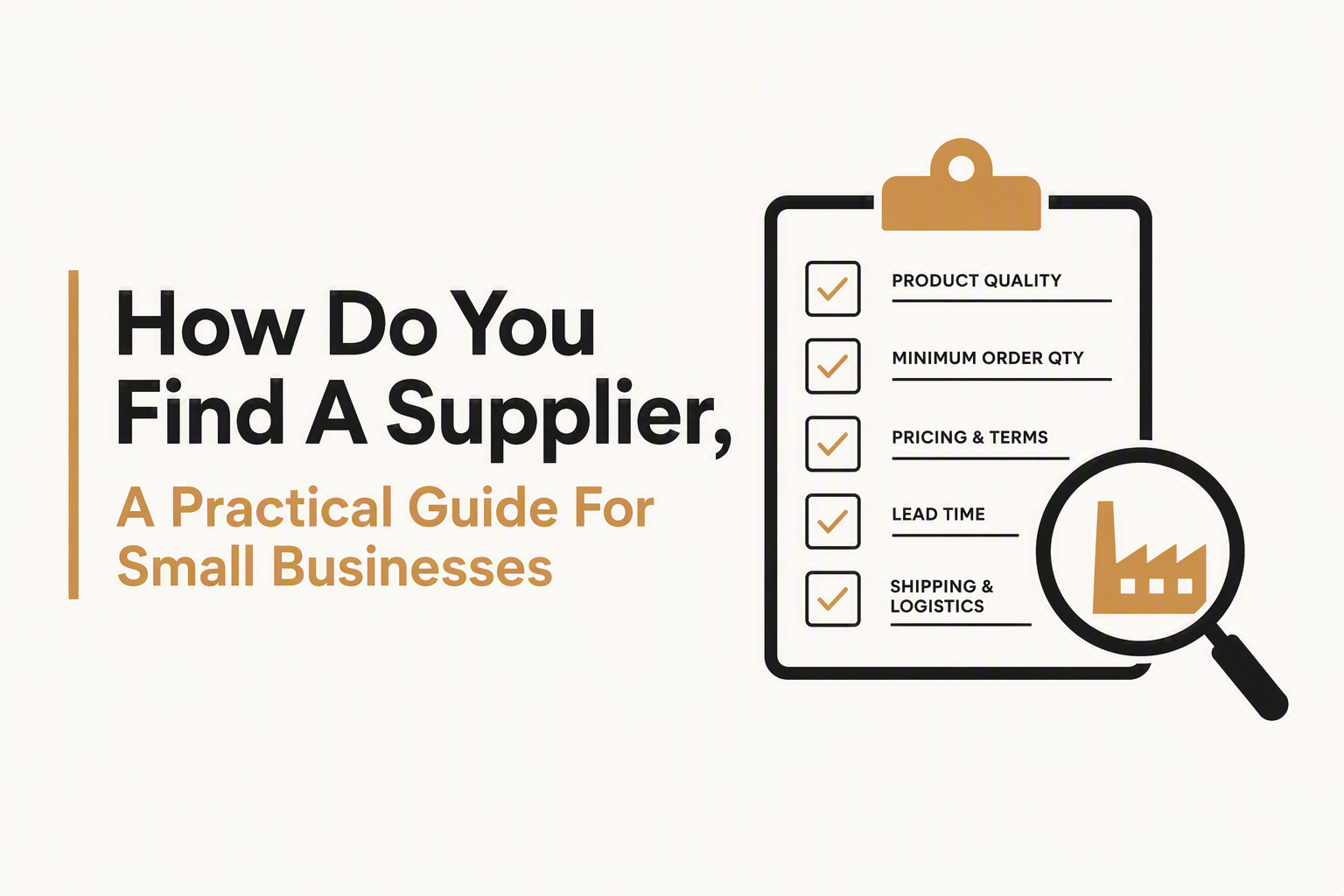
Start With Your Supplier Requirements Before You Search
How do you find a supplier efficiently? You start by defining what “qualified” means for your product and your business so you can filter options in minutes, not days.
Action: Write a one page requirement sheet
Outcome: You get consistent quotes and you avoid suppliers who were never a fit.
- Product definition: SKU list, photos or drawings, target materials, finishes, packaging, and labeling requirements.
- Quality level: what “pass” looks like (for example: color tolerance, allowed cosmetic defects, functional tests, carton drop test requirement). If you do not have formal specs, write “acceptable / unacceptable” photo examples.
- Order profile: target MOQ per SKU, expected reorder frequency, and whether you need mixed SKU cartons.
- Commercial limits: target unit price range, max total landed cost assumption, and preferred Incoterms (EXW, FOB, CIF).
- Lead time needs: target production days and shipping mode (air vs sea). State any hard deadlines.
- Compliance needs: country specific labeling, required test reports, or restricted materials. If you are unsure, note the destination market so the supplier can advise.
- Non negotiables: examples: “no substitute materials,” “must accept third party inspection,” “must provide pre production sample,” “must support small batches.”
Action: Decide your “must have” vs “nice to have” filters
Outcome: You stop over optimizing and you can shortlist 5 to 10 suppliers quickly.
Use this simple split:
- Must have: can make the product category, accepts your MOQ, can meet lead time window, can ship to your market, responds within 2 business days.
- Nice to have: custom packaging, lower MOQ, better payment terms, multiple materials, strong English support, strong sample capability.
In our experience working with small resellers, the single biggest time saver is setting a hard MOQ ceiling and a hard lead time ceiling up front, because it eliminates the most common “great supplier but not for us” outcomes.
Find Suppliers In Directories, Marketplaces, Trade Shows, And Search Results
How do you find a supplier depends on your risk tolerance and how customized your product is, because different channels optimize for different things such as speed, price transparency, or depth of vetting.
Action: Pick the right sourcing channels for your goal
Outcome: You search where qualified suppliers are most likely to show up for your situation.
- Directories: better for building a longlist and finding established exporters. Look for company details, location, and product focus.
- B2B marketplaces: faster for quick comparisons and low commitment sampling, but requires stricter verification because listings can be noisy.
- Trade shows: best when you need to assess product quality in person and meet multiple factories in a short time window.
- Search results: useful for niche products, brand owned factories, or when you want to find a supplier’s own website and certifications.
- Referrals: best for reducing risk, especially when the referrer buys the same product category.
If you want a deeper checklist for channel selection, see where to look for suppliers.
Action: Build a longlist with consistent data fields
Outcome: You can compare like for like instead of juggling random screenshots and chat threads.
Create a spreadsheet (or a database) and capture the same fields for every candidate:
- Company name (legal name if possible) and website
- Country, province, and factory address (not just a city)
- Supplier type (manufacturer, wholesaler, distributor, agent)
- Main products and materials
- MOQ, lead time estimate, and sample policy
- Certifications claimed (leave blank until verified)
- Contact person, email, WhatsApp/WeChat, and response time
Action: Use a two pass search protocol
Outcome: You avoid getting stuck in browsing mode.
- Pass 1 (breadth, 60 to 90 minutes): collect 20 to 30 candidates quickly, do not evaluate deeply.
- Pass 2 (depth, 60 to 120 minutes): narrow to 8 to 12 by checking product fit, minimums, and basic legitimacy signals such as a real address and consistent product catalog.
For a practical framework on qualifying signals, how to look for suppliers pairs well with this SOP.
Match The Supplier Type To Your Business Model
How do you find a supplier that will actually perform after payment? You choose a supplier type that matches your order size, customization needs, and operational capacity.
Action: Classify each candidate by supplier type
Outcome: You set the right expectations for price, MOQ, customization, and accountability.
- Manufacturer: best when you need customization, stable reorders, and the lowest unit cost at scale; typically higher MOQs and longer setup time.
- Wholesaler: best for faster buying and smaller quantities; less customization; unit cost higher than a factory.
- Distributor: best when you want branded or standardized items with local inventory; often strongest on delivery speed.
- Service provider (agent / sourcing company): best when you need help coordinating, auditing, or consolidating orders; quality depends on their process.
Action: Use a quick “fit test” to pick the right route
Outcome: You avoid factory conversations when you really need inventory, or vice versa.
- If you need custom specs or private label, prioritize manufacturers.
- If you need fast restock and low risk, prioritize distributors with local stock.
- If you are testing demand with small batches, prioritize wholesalers or factories that support low MOQs.
- If you cannot manage time zones, inspections, or multi supplier coordination, use a service provider with clear deliverables.
We initially assumed “manufacturer” is always the best answer, but our team found that early stage sellers often succeed faster by buying from a wholesaler for the first 1 to 2 cycles, then switching to a factory once the SKU and reorder volume stabilize.
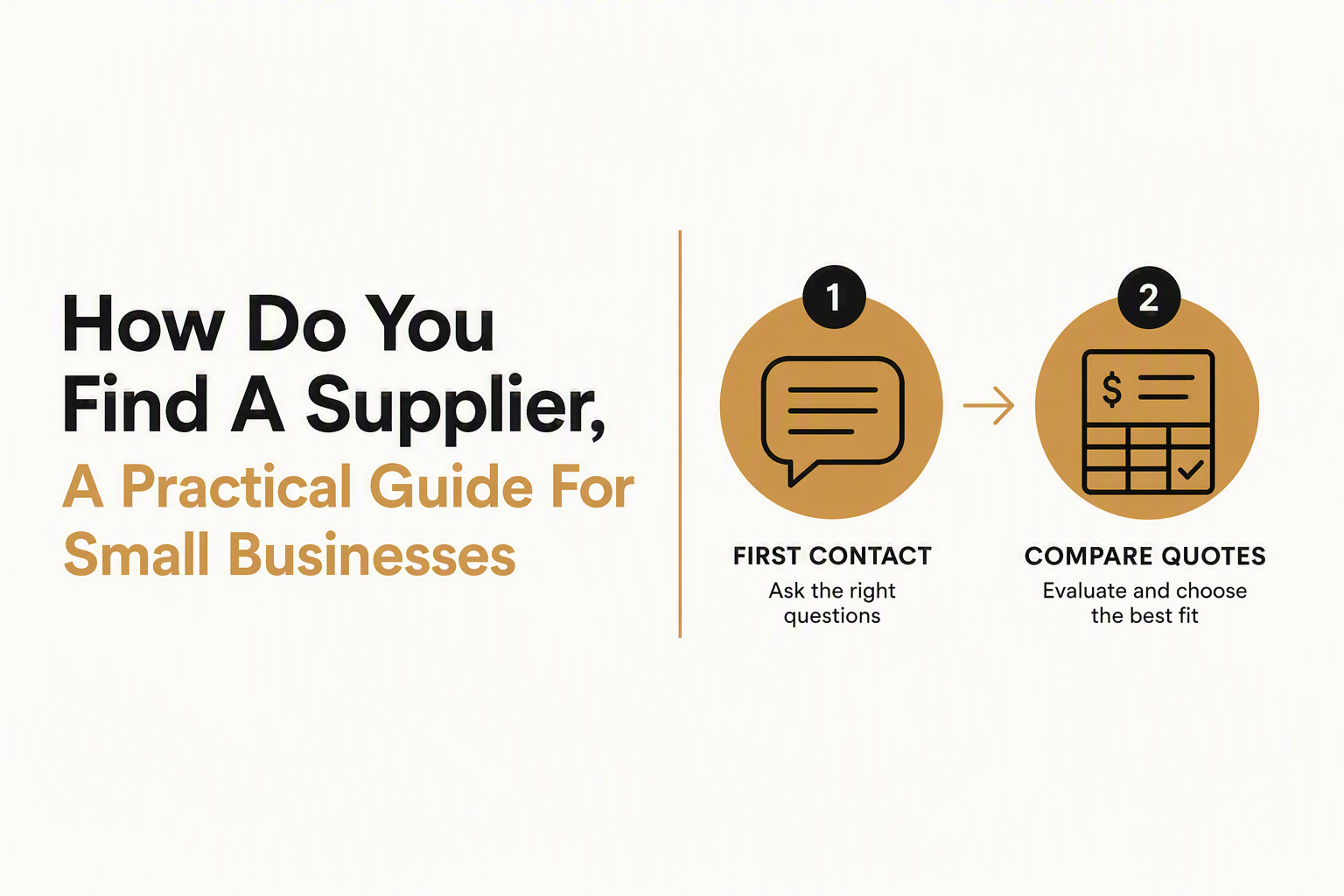
Send A First Contact Email And Request A Quote
How do you find a supplier that responds with a usable quote? You send a structured first message that makes it easy to say yes or no and hard to misunderstand your specs.
Action: Send a first contact email that qualifies and requests an RFQ
Outcome: You get comparable quotes and you learn who communicates well.
First contact email template (copy and edit):
Subject: RFQ for [Product] + sample request (delivery to [Country])
Hello [Name],
My name is [Your Name] from [Company]. We are sourcing a supplier for [product category]. Please confirm if you can produce the attached / linked specification.
1) Are you a manufacturer or trading company? Where is the factory located?
2) MOQ per SKU and MOQ for a mixed order?
3) Unit price for 500 / 1,000 / 3,000 units (or the quantities you can offer). Please specify Incoterms (EXW/FOB).
4) Sample cost, sample lead time, and whether sample cost is refundable after order.
5) Production lead time for first order and repeat order.
6) Payment terms you can offer (for example 30/70, LC, etc.).
7) What quality checks do you run before shipment? Can we arrange third party inspection?
8) Please share product photos, material options, and packaging details.
Thank you,
[Signature]
Action: Add 5 RFQ questions that expose hidden costs
Outcome: You reduce surprises after you think you agreed on price.
- Tooling or mold fees: “Is there any tooling cost? If yes, how is it amortized and who owns the tooling?”
- Packaging and labeling: “What carton spec is included? Any added cost for inserts, barcodes, or warning labels?”
- Material substitution controls: “How do you control material changes between sample and production?”
- Defect and remake policy: “What is your policy if goods fail inspection or arrive damaged?”
- Spare parts and after sales: “Can you supply spare parts? Lead time and pricing?”
Action: Set a response deadline and a next step
Outcome: You keep momentum and avoid endless back and forth.
Add a line like: “If this is a fit, please reply by [date] and we will shortlist suppliers for sampling this week.” Suppliers who cannot respond to a clear deadline often struggle later with production updates and shipping documents.
Compare Quotes, Samples, Lead Times, And Terms
How do you find a supplier worth choosing after you get quotes? You compare offers using a single scorecard that includes quality risk, lead time risk, and payment risk, not just unit price.
Action: Normalize quotes before you compare
Outcome: You stop comparing apples to oranges.
- Align Incoterms: compare EXW to EXW or FOB to FOB, not mixed.
- Align quantities: use the same quantity tiers across suppliers.
- List inclusions: confirm packaging, labels, spare parts, and accessories are included.
- Confirm currency and validity: quote currency, quote validity days, and any seasonal pricing notes.
Action: Use a simple 100 point supplier scorecard
Outcome: You can justify your decision and explain tradeoffs to partners or stakeholders.
- Price and total cost (30 points): unit price, packaging, tooling, expected freight class, payment fees.
- Quality confidence (30 points): sample result, clarity of specs, willingness to accept inspection, defect policy.
- Lead time and capacity (20 points): sample lead time, production lead time, peak season constraints.
- Commercial terms (10 points): payment terms, flexibility on MOQ, warranty.
- Communication (10 points): response speed, completeness, consistency across messages.
When we tested this scorecard approach across multiple categories, the pattern was clear: suppliers with the best “communication” scores were far less likely to miss documentation details like carton marks or barcode placement, even when their unit price was not the lowest.
Action: Run a controlled sample validation protocol
Outcome: You detect quality drift early, before you commit to a large deposit.
- Order 2 samples when possible: one for functional testing, one as a sealed “golden sample.”
- Photograph and measure: record dimensions, weight, finish, and packaging.
- Test what customers actually do: assembly, cleaning, heat exposure, and basic stress tests relevant to the product.
- Lock the spec: write a short “approved sample” note with photos and version date.
Verify The Supplier And Spot Scam Red Flags
How do you find a supplier you can pay with confidence? You verify identity, operating capability, and trade behavior using a checklist before you send significant funds.
Action: Verify business identity and payment safety
Outcome: You reduce the risk of paying the wrong entity or a fraudulent account.
- Collect documents: business registration, factory address, and an official company stamp if common in that country.
- Match details: company name on documents should match the name on the proforma invoice and the bank account holder name.
- Confirm contact channels: email domain that matches the company site is a positive signal; free email is not an automatic no, but requires more checks.
- Use safer payments when unsure: start smaller, avoid full upfront payment, and treat “urgent today” pressure as a risk signal.
Action: Validate capability with proof, not promises
Outcome: You confirm the supplier can make your product repeatedly, not just one good sample.
- Ask for production process photos or videos: especially for your product category and material.
- Request recent QC records: even anonymized, you want to see they measure and document.
- Check consistency: product photos, catalog, and claimed materials should not contradict each other.
- Request references carefully: if they provide references, validate that the reference company is real and reachable.
Action: Watch for common scam and risk red flags
Outcome: You avoid the highest probability failure modes.
- Red flag: bank account in a different company name or in a different country with no clear reason.
- Red flag: refuses third party inspection or will only allow inspection after full payment.
- Red flag: cannot answer basic technical questions about materials, tolerances, or packaging.
- Red flag: extremely low price compared to every other quote without a clear explanation.
- Red flag: inconsistent addresses, changing company names, or pressure to move off traceable channels immediately.
Golden Rule: Treat your first transaction as a validation project, not a procurement win. The goal is to verify repeatability: stable specs, stable communication, stable payment process, and stable quality controls.
Build A Working Relationship After The First Order
How do you find a supplier you can keep long term? You create a simple operating rhythm for communication, change control, and reorders after the first shipment.
Action: Establish a communication cadence and a single source of truth
Outcome: You prevent version mix ups and reduce rework.
- Weekly production update: ask for a short update with photos at defined milestones (materials in, first article, mid production, packed).
- Change control: any change to material, finish, packaging, or carton marking must be confirmed in writing with a version date.
- Shared file structure: keep approved sample photos, spec sheet, and packaging art in one folder with clear naming.
Action: Run a “first order retro” and lock improvements
Outcome: The second order is smoother and cheaper operationally.
- What defects appeared and at what frequency?
- What caused delays: raw materials, capacity, approvals, shipping docs?
- What questions did the supplier ask repeatedly that you can pre answer in your RFQ template?
- What packaging or labeling issues created extra work on arrival?
After running multiple first order retros, our team found that documenting three things reduces repeat issues most: approved sample photos, carton labeling rules, and the exact inspection criteria for the top 3 defects.
Action: Plan reorders based on lead time math, not hope
Outcome: You reduce stockouts without over ordering.
- Reorder point (simple version): average weekly sales x (production lead time weeks + shipping lead time weeks) + buffer stock.
- Buffer stock: set a buffer that matches variability. If demand and lead times are unstable, increase buffer until your data improves.
| Stage | What you do | What you record | Decision rule |
|---|---|---|---|
| Requirements | Define specs, MOQ, lead time, non negotiables | One page requirement sheet | If requirements are unclear, do not request quotes yet |
| Search | Build longlist from directories, marketplaces, shows, search | 20 to 30 candidates with consistent fields | Shortlist to 8 to 12 by fit and legitimacy signals |
| RFQ | Send structured email + hidden cost questions | Comparable quotes and timelines | Eliminate suppliers who dodge specifics or miss deadlines |
| Compare | Normalize Incoterms and quantities; scorecard | 100 point score per supplier | Sample top 2 to 3 suppliers, not the whole list |
| Verify | Document checks, payment safety, capability proof | Verification checklist outcomes | No large deposits until identity and terms are consistent |
| First order | Small controlled PO; inspection; retro | Approved sample + defect log | Scale volume only after repeatability is proven |
FAQ about finding and choosing suppliers
If you want help verifying shortlisted vendors and managing quality checks after you narrow your options, Ant Sourcing can support supplier verification and quality control so you can move from “found a name” to “confident first order” with less risk.
How To Find The Best Suppliers, A Practical Workflow and Scorecard
Learn how to find the best suppliers using a repeatable checklist, vetting steps, and a simple weighted scorecard for objective comparison.
Purpose Of Supplier Evaluation Explained, The 5 Reasons It Matters
Learn the purpose of supplier evaluation, how it works in sourcing, and how to build a simple scorecard with weighted criteria for better decisions.
Where To Look For Suppliers, By Product Type, Country, And Risk Level
Learn where to look for suppliers by product type, country, and risk level, plus a practical checklist to research and shortlist partners fast.