
How To Look For Suppliers, A Practical Framework To Find And Verify Reliable Partners
How to look for suppliers is easiest when you follow a repeatable checklist that starts with clear requirements, then moves through sourcing channels, verification, scoring, and a controlled first order.
- Start with a bid-ready requirement sheet so suppliers quote the same scope.
- Use multiple lead sources, then verify legitimacy and capability before sharing sensitive details or paying deposits.
- Shortlist with a weighted scorecard and run a small pilot order with a defined QC plan.
Start with requirements that suppliers can actually bid on
How to look for suppliers efficiently starts by writing requirements in a way factories can price, schedule, and accept without guessing.
Stage 1 checklist: define the “bid package” (what you send before RFQs)
- Product spec sheet: dimensions, drawings, photos, tolerances, packaging, labeling, and any known failure points (for example, edge chipping, color consistency, warp).
- Target order plan: first order quantity, expected re-order frequency, and a realistic annual volume range.
- Quality expectations: what defects are unacceptable, what is acceptable, and how you want inspections handled (pre-production, during production, pre-shipment).
- Compliance needs (only if applicable): list the specific market and product constraints you actually must meet (for example, destination country labeling rules, restricted substances, or customer-specific requirements). Do not ask for “all certificates.”
- Commercial constraints: required Incoterms, destination port, target lead time window, and payment preference.
- Must-have documents: packing list, commercial invoice, bill of lading, material declarations if needed, and any product test reports you truly require.
Stage 2 checklist: define decision gates before you start searching
- Gate A, fit: supplier can make your product category and materials, and can meet your MOQ and lead time.
- Gate B, proof: supplier can show evidence of exports, stable production, and quality controls.
- Gate C, pilot: supplier accepts your inspection plan and a small trial order structure.
Confirm directly with the supplier: MOQ, lead time, what is included in the quote (packaging, tooling, testing), and what part of production they do in-house versus subcontract.
Where to look for suppliers and what each source is good for
How to look for suppliers without wasting weeks comes down to matching the search channel to the type of evidence you need and the risk you can tolerate.
Stage 3 checklist: pick sourcing channels based on your goal
- Marketplaces (broad discovery): good for fast lead volume and initial category scans. Weak for verifying who actually manufactures unless you validate.
- Trade shows (capability screening): good for seeing product quality, meeting technical staff, and comparing many suppliers in one place. Weak for deep validation without follow-up.
- Referrals (trust transfer): good when the referrer has bought the same product category recently. Weak when the referrer is not the end buyer or cannot share proof.
- Industry associations and local networks (narrow, higher relevance): good for region-specific clusters (for example, furniture manufacturing provinces). Weak if lists are outdated.
- Sourcing agents and consultants (process support): good for factory shortlisting, language support, and on-site checks. Weak if incentives are unclear, so align on fees and non-circumvention.
Stage 4 checklist: collect comparable evidence from each lead source
- Company identifiers: registered company name, address, tax ID or business registration number (format varies by country).
- Factory footprint: photos or videos of production lines relevant to your product, plus a simple process map.
- Export activity proof: sample shipping documents with sensitive parts redacted, or other verifiable export indicators.
- Customer fit: the types of buyers they serve (retail, contract, OEM), and typical order sizes.
In our experience working with first-time importers, the fastest way to reduce “pretty catalog” leads is to require a short evidence pack before you schedule a call.
How to verify a supplier before you send money or place a trial order
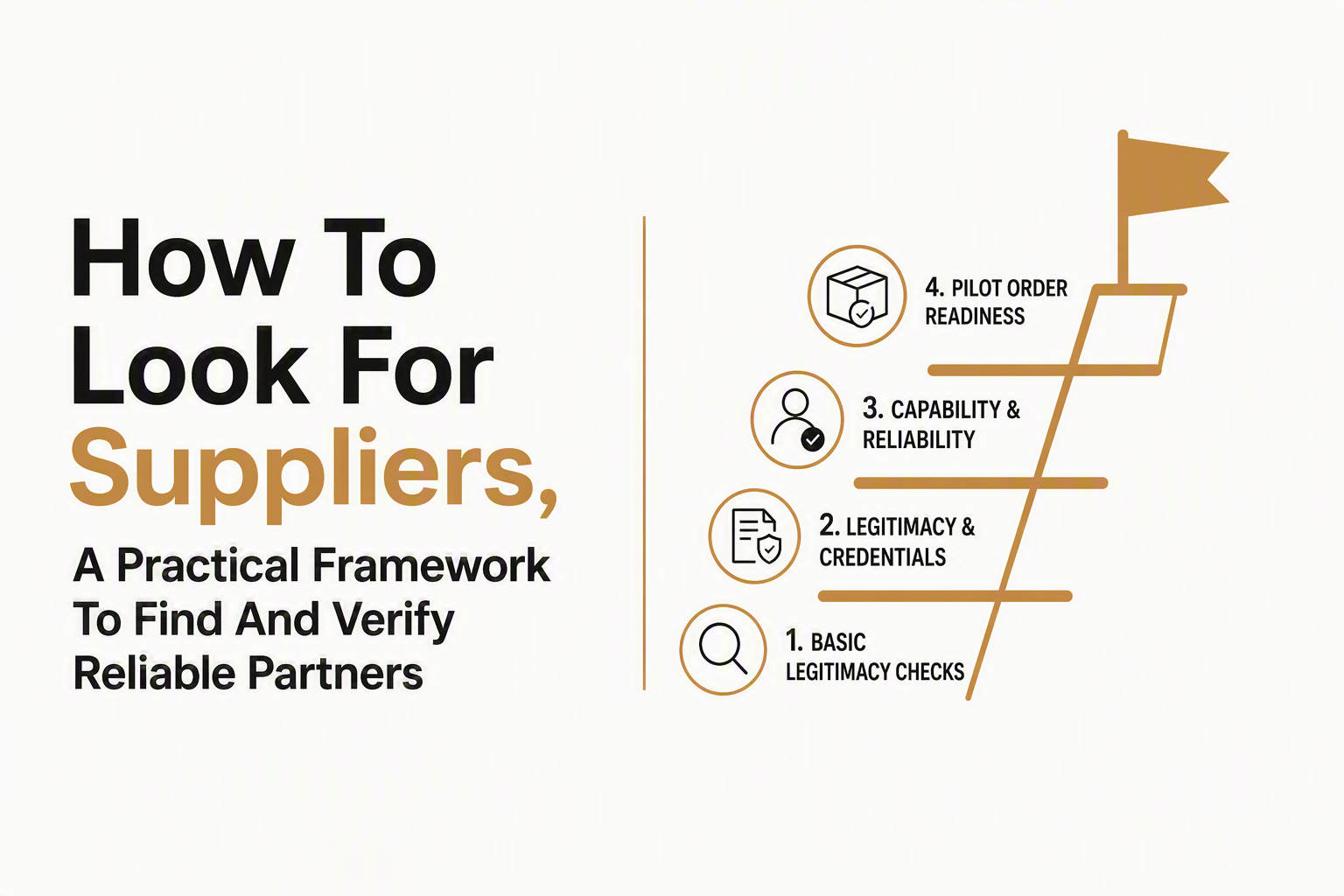
How to look for suppliers safely requires a verification ladder that moves from identity checks to capability checks to quality system checks, in that order.
Stage 5 checklist: verification ladder (run top to bottom)
- Legitimacy
- Match company name and address across website, invoices, and registration documents.
- Check the factory address is not a residential address or unrelated office building.
- Verify bank account name matches the contracting legal entity.
- Manufacturing capability
- Ask for process-specific evidence: for furniture, finishing line, kiln-drying or wood conditioning approach, assembly, packing.
- Request recent production photos for similar SKUs, not showroom-only images.
- Confirm whether key steps are subcontracted (painting, metal parts, upholstery) and who controls QC for those steps.
- Quality controls
- Ask for their incoming, in-process, and final inspection checkpoints (a simple checklist is enough).
- Request one real corrective action example: what defect occurred, how they contained it, and what changed.
- Trade and references
- Ask for buyer references you can contact, ideally in your market and product type.
- Cross-check claimed buyers with any available trade or shipment indicators when possible.
Stage 6 checklist: documents to request (and how to treat them)
- Business registration: treat as identity evidence, not quality evidence.
- Certificates: treat as claims until you verify issuer, scope, site address, and validity dates. Ask for the certificate number and issuing body so you can verify directly with the issuer when possible.
- Test reports: confirm the report is for the same product construction, not “similar.” Check lab name, sample description, and date.
Confirm directly with the supplier: contracting entity, bank beneficiary name, factory address used for production, and whether your order will be produced at that site or another facility.
Shortlist and contact suppliers using a simple scoring system
How to look for suppliers in a way your team can repeat is to score every candidate against the same weighted criteria before you negotiate.
Stage 7 checklist: build a one-page scorecard (example weights)
- Capability fit (25%): materials, processes, and similar products shipped before.
- Quality system (20%): inspection points, defect response, willingness to support QC.
- Commercial fit (20%): MOQ, lead time, Incoterms, payment terms.
- Communication (15%): clarity, speed, and whether they answer questions with evidence.
- Risk indicators (20%): mismatch between claimed and evidenced factory, vague documents, subcontracting opacity.
Stage 8 checklist: an outreach workflow that forces comparable answers
- Message 1, evidence request: ask for company identifiers, factory address, 3 similar product photos, process overview, MOQ, lead time, and export markets.
- Message 2, RFQ: only send detailed specs after Gate A and Gate B pass. Require quote to include validity date, lead time breakdown, packaging, and tooling assumptions.
- Message 3, validation: ask 5 specific questions tied to risk, such as “Which steps are subcontracted?” and “What is your final inspection sampling method?”
What surprised our team was how often the “best price” lead fell two grades in ranking once we scored evidence quality and responsiveness separately from unit cost.
Common red flags and how to avoid costly supplier mistakes
How to look for suppliers without getting trapped by low-price bait is to treat certain patterns as stop signs unless the supplier can produce clear proof.
Stage 9 checklist: red flags that should pause the process
- Bait-and-switch quoting: low initial quote followed by rapid add-ons for packaging, material changes, or “unavoidable” fees. Fix: require an itemized quote template.
- Trading company disguised as a factory: no production evidence, office-only videos, inconsistent factory address. Fix: require a dated walkthrough video showing key processes for your product.
- Unverifiable certificates: missing scope, mismatched addresses, or expired dates. Fix: verify issuer and site details; do not accept screenshots.
- Inconsistent materials or construction: sample looks good but bill of materials is vague. Fix: lock materials in writing and inspect against it.
- Hidden subcontracting: supplier cannot explain who does finishing, welding, plating, or upholstery. Fix: require disclosure of subcontract steps and who owns QC.
Stage 10 checklist: “price is low” diagnostics (before you celebrate)
- Check if the quote assumes a different material grade, thickness, or construction method.
- Check if packaging spec is simplified (less protection, higher damage risk).
- Check if lead time is realistic for the stated capacity and seasonality.
- Check if payment terms shift risk to you (high deposit, weak remedies).
From shortlist to first purchase what to do next
How to look for suppliers end-to-end includes a controlled first purchase that tests quality consistency, communication, and on-time delivery before you scale.
Stage 11 checklist: run the first order like a test, not a leap of faith
- RFQ and quotation lock: confirm specs, packaging, lead time, and payment terms in writing, including quote validity and change control.
- Sampling plan: define what the sample must prove (finish durability, fit, load, appearance) and what happens if it fails (rework, resample, cancel).
- Pilot order size: place an order that is big enough to run real production, but small enough to contain risk if defects appear.
- QC plan: schedule checkpoints and define what “pass” means. If you use third-party inspections, agree on timing and who pays for re-inspections.
- Payment and shipment controls: match payment milestones to evidence (photos, inspection results, shipping documents). Avoid paying the full balance before you have objective shipment and QC proof.
After running early-stage supplier evaluations for growing brands, the pattern was clear: problems show up at handoffs, such as material receiving, finishing, and packing, so those are the checkpoints to make non-negotiable on the first order.
Confirm directly with the supplier: final production schedule, inspection dates, packing method, carton markings, and the exact documents you will receive before shipment release.
| Decision gate | What you check | Evidence to collect | Decision |
|---|---|---|---|
| Gate A: Fit | Category, materials, MOQ, lead time | Capability answers, photos of similar SKUs, stated MOQ and lead time | Proceed to verification or reject |
| Gate B: Proof | Legitimacy and real manufacturing | Registration docs, matching address, walkthrough video, export indicators | Proceed to RFQ or hold |
| Gate C: Pilot readiness | Quality controls and cooperation | QC checklist, corrective action example, agreement to inspection plan | Sample and pilot order |
| Gate D: Scale | Consistency and delivery performance | Pilot defects data, on-time shipment record, stable communication | Negotiate longer-term terms |
FAQ
If you want a more structured way to research and verify suppliers in Vietnam and keep QC documentation organized, Ant Sourcing can help you discover suppliers, validate trade and company details, and coordinate verification and inspections. You can also adapt the checklist above into an internal template and use it on every new supplier before RFQs and trial orders.
How To Find The Best Suppliers, A Practical Workflow and Scorecard
Learn how to find the best suppliers using a repeatable checklist, vetting steps, and a simple weighted scorecard for objective comparison.
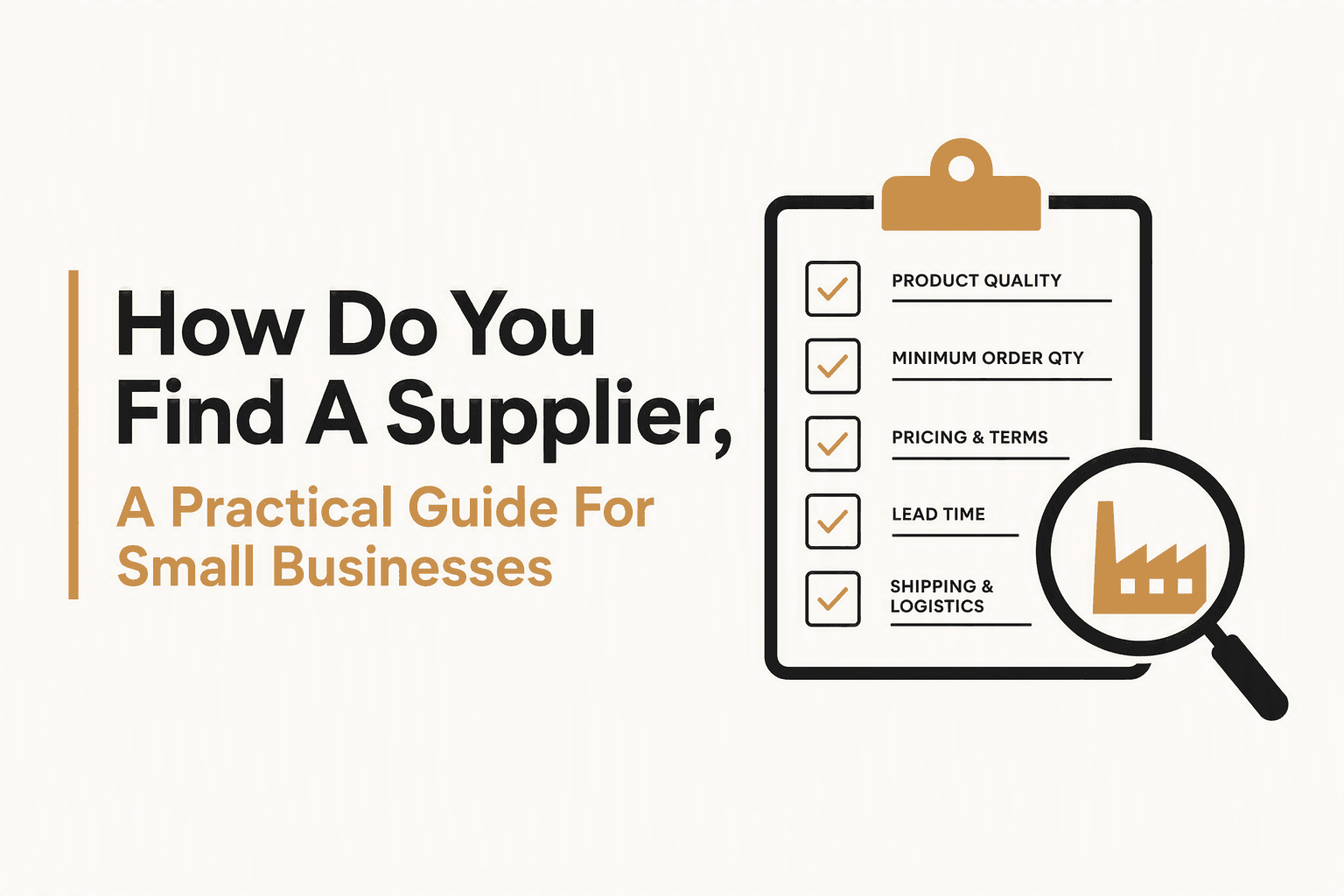
How Do You Find A Supplier, A Practical Guide For Small Businesses
Learn how do you find a supplier with a simple SOP: set requirements, search channels, email RFQs, compare quotes, verify, and place your first order.
Purpose Of Supplier Evaluation Explained, The 5 Reasons It Matters
Learn the purpose of supplier evaluation, how it works in sourcing, and how to build a simple scorecard with weighted criteria for better decisions.