
How To Find Suppliers For Products - A Simple Sourcing Framework
How to find suppliers for products comes down to running a repeatable workflow: write a clear product brief, search the right channels, screen suppliers fast, then compare quotes and samples on the same checklist so you can shortlist with confidence.
- Start with a product brief (specs, target order volume, quality bar, non-negotiables) so you do not waste weeks talking to the wrong factories.
- Match channels to your product and budget by using a simple channel-fit matrix instead of searching everywhere at once.
- Standardize screening, RFQs, and samples so pricing and quality differences are real, not caused by inconsistent questions.
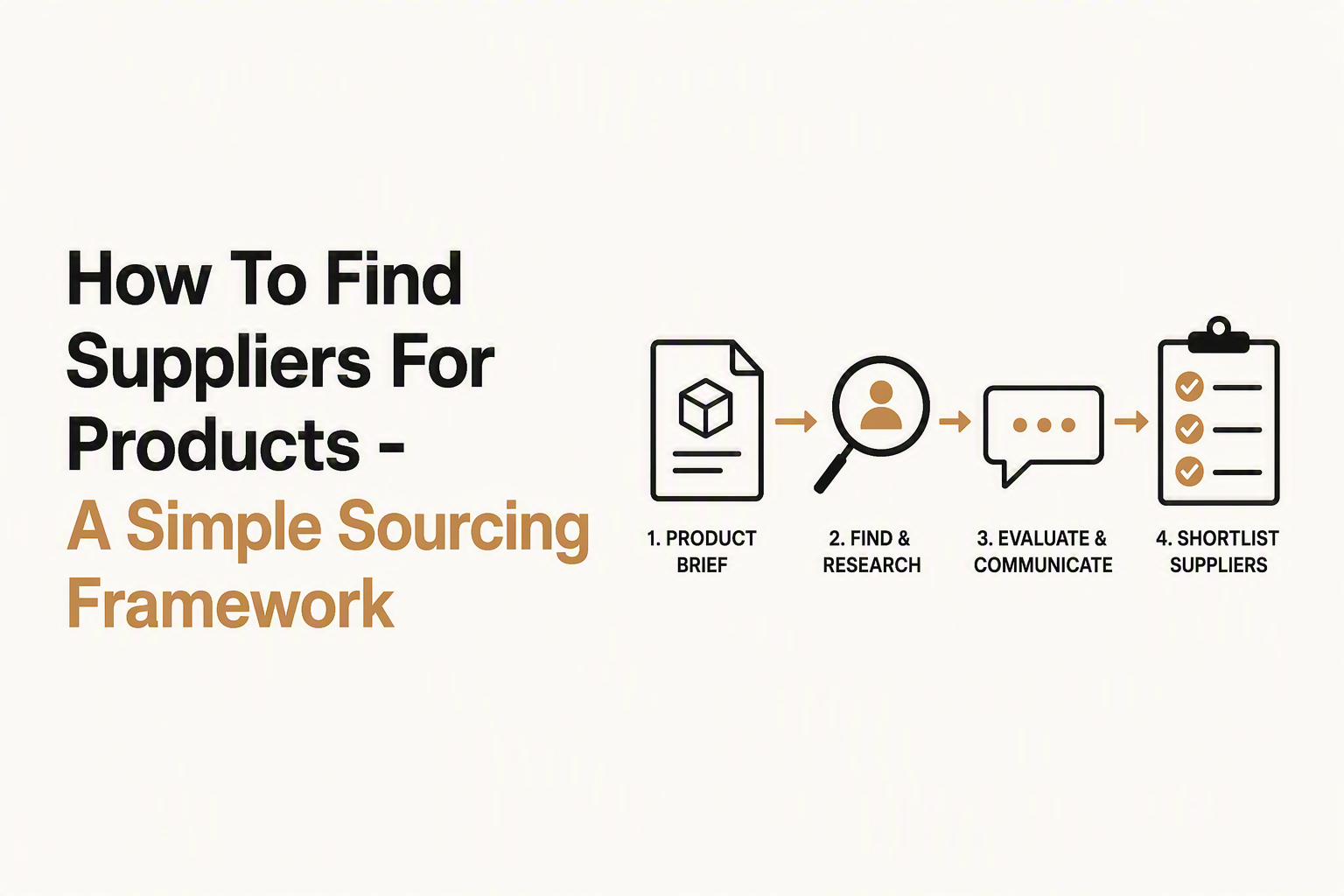
Start with a clear product brief before you search
A clear product brief is the fastest way to find suppliers that can actually build your product at your target cost and quality level. Without it, supplier conversations drift, quotes become incomparable, and you end up validating the same basics repeatedly.
Action: Write a one-page Product Brief and a pass or fail spec sheet
Outcome: Suppliers self-qualify quickly, and you can spot mismatch in the first email instead of after a week of calls.
- Product definition: SKU name, use case, target customer, and target retail price (or target landed cost).
- Technical specs: dimensions, materials, finishes, tolerances, packaging requirements, labeling, compliance needs (if any).
- Quality bar: must-pass checks (visual defects, functional tests, durability expectations) and what counts as a reject.
- Order profile: first order quantity, expected reorder quantity, number of SKUs, and mix per SKU.
- Commercial constraints: target ex-works or FOB price, Incoterms you can support, and payment terms you can accept.
- Non-negotiables: required certifications, required equipment, required materials, language/time zone constraints.
Action: Define your “supplier fit” criteria before contacting anyone
Outcome: You filter suppliers using rules, not gut feel.
Use a simple 3-part fit model and score each supplier 0 to 2 on each dimension.
- Capability fit: Can they produce the category, materials, and finish consistently?
- Capacity fit: Can they support your order profile and lead time expectations?
- Commercial fit: Can they meet your target price range with acceptable terms?
Minimum threshold: require at least 4 out of 6 points to proceed to RFQ. In our experience working with first-time importers, this one rule prevents the most common mistake: falling in love with a supplier that is “nice” but structurally mismatched to your order size.
Action: Prepare a “quote-ready” info pack
Outcome: Quotes arrive faster and with fewer assumptions.
- Drawings or reference photos with annotations
- Bill of materials (even a rough one)
- Packaging spec (carton size target, drop test needs if relevant)
- Target timeline (sample deadline and desired production window)
Search supplier channels that match your product and budget
How to find suppliers for products efficiently means choosing 2 to 3 channels that fit your category, order size, and risk tolerance, then executing a structured search inside each. Searching every marketplace and directory at once usually creates noise, not options.
Action: Pick channels using a channel-fit matrix
Outcome: You spend time where you are most likely to find viable suppliers.
- Online directories and marketplaces: Good for fast discovery and broad scanning, but requires stronger screening.
- Trade shows: Best for tactile categories and relationship building; higher upfront time and travel cost.
- Import and shipment records (where available): Useful for validating that a supplier exports your category and to which markets.
- Industry associations and clusters: Helpful for specialized categories; quality varies by association.
- Referrals: Often higher trust, but can limit competition and price discovery.
Action: Execute a repeatable search protocol
Outcome: You build a longlist you can defend instead of a random set of bookmarks.
- Define search strings: category + material + process + location (example: “rubberwood dining chair manufacturer Vietnam”).
- Capture evidence: website, product pages, factory address, export markets, and any public identifiers.
- Tag by fit: capability, capacity, and commercial fit (your scoring model from section 1).
- Stop rule: stop adding suppliers when you have 20 to 30 plausible candidates, then shift to screening.
We initially assumed “more suppliers” would always produce better pricing, but after running repeated sourcing cycles, the pattern was clear: once your longlist passes about 30 entries, attention drops and screening quality becomes the bottleneck.
Action: Use internal resources for deeper context before outreach
Outcome: You approach suppliers with informed questions, which increases response quality.
If Vietnam is a target market, Ant Sourcing can be used as an execution engine to research suppliers inside a Vietnam supply network and review structured company context and trade activity before you send your first email. The goal is not to find a name, but to understand whether a supplier is worth contacting.
Screen suppliers for basic reliability and fit
Supplier screening works best as a two-stage gate: a fast legitimacy check first, then a capability check second, before you invest time in detailed RFQs and samples. This is where most beginners lose time because they ask detailed product questions before confirming the supplier is real and responsive.
Action: Run a 15-minute legitimacy and communication check
Outcome: You eliminate high-risk suppliers early.
- Identity match: company name, address, and contact email domain are consistent across materials.
- Responsiveness: reply within 2 business days with direct answers, not only brochures.
- Clarity: they confirm what they can and cannot do (for example, “we can do rubberwood, not oak”).
- Documentation readiness: they can share product photos, basic spec sheets, and packaging options.
Action: Validate production capability with proof, not promises
Outcome: You confirm they can make your product category consistently.
- Category proof: recent production photos or catalog pages that match your product type.
- Materials proof: confirmation of key materials and finishes (and what they typically use).
- Process proof: a simple process explanation, including QC steps they already perform.
- Export readiness: ability to pack to your requirements and ship under your Incoterms.
A practical benchmark: if a supplier cannot answer 8 out of 10 basic screening questions clearly, do not advance them to the quote stage, even if their website looks strong. After running supplier audits for quality-sensitive products, our team found that communication quality at screening is often the best early signal of how production issues will be handled later.
Expert insight box: Golden rule and common pitfall
Golden rule: Require “evidence per claim.” If they say they export to your market, ask which product category and typical customer profile. If they say they have QC, ask what gets checked at incoming, in-process, and final.
Common pitfall: Comparing suppliers based on a single low quote before validating the assumptions behind it (materials, packaging, and included tooling).
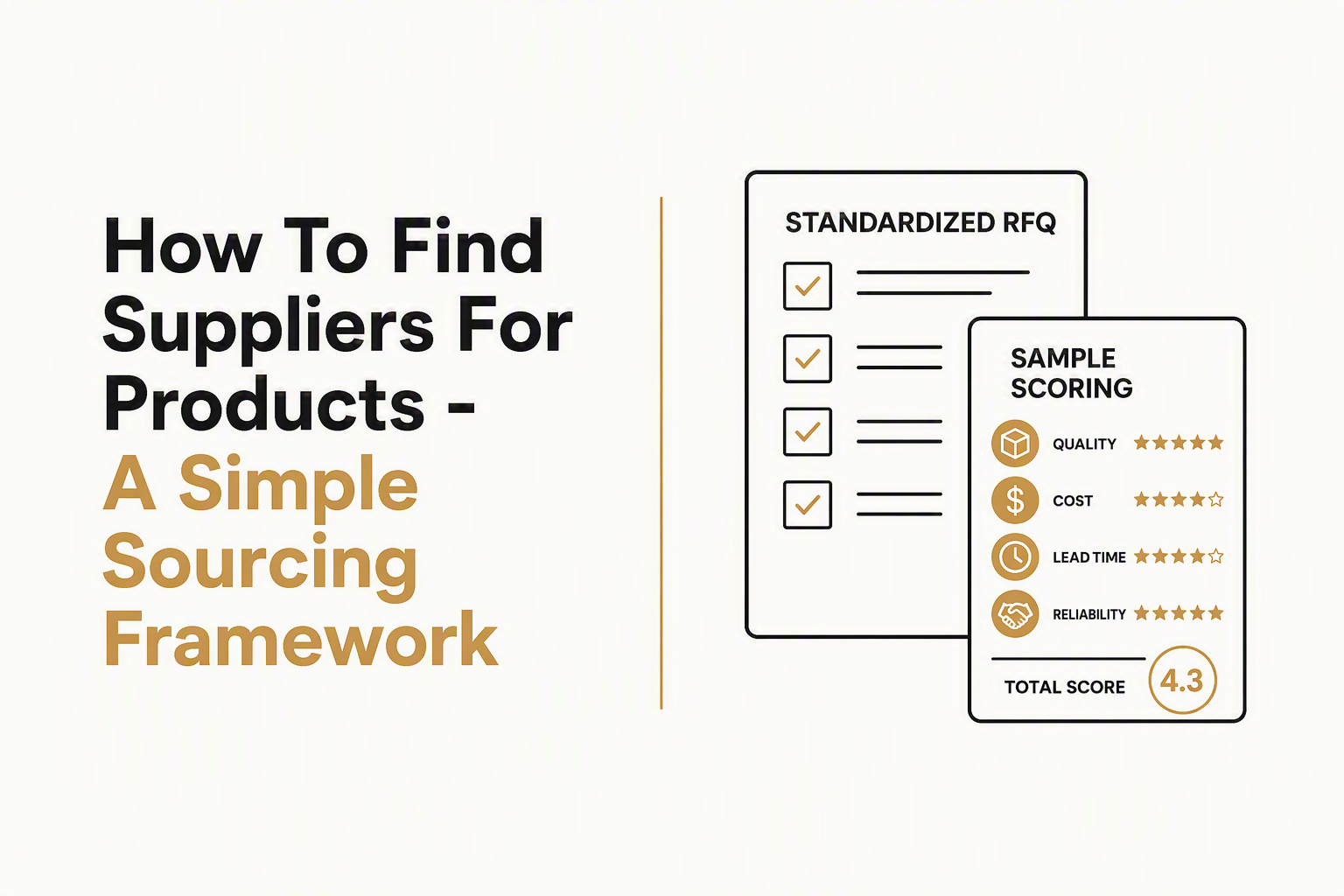
Request quotes and samples using the same checklist
How to find suppliers for products you can trust requires standardized RFQs and sample reviews so you can compare “like for like” across multiple suppliers. The simplest way to do this is to lock your RFQ template, then score quotes and samples with the same rubric.
Action: Send a standardized RFQ template to your shortlist
Outcome: Quotes become directly comparable, and suppliers cannot hide costs in vague assumptions.
- Unit price: quote for your exact spec and packaging, with MOQ and price breaks (example: 300, 500, 1,000 units).
- Tooling and setup: any molds, fixtures, jigs, or one-time setup fees.
- Lead times: sample lead time and production lead time.
- Payment terms: deposit and balance terms.
- Incoterms: EXW, FOB, or other terms you need.
- Quality agreement: what happens if the shipment fails inspection or arrives with defects.
Action: Score quotes with a simple landed-cost and risk view
Outcome: You select based on true cost and controllable risk, not headline price.
Use a 2-layer comparison:
- Cost layer: unit price + packaging + tooling amortized across first order + estimated freight and duties (if known).
- Risk layer: clarity of quote, lead time reliability, and willingness to align on QC and defect handling.
Action: Evaluate samples with a pass-fail rubric
Outcome: Sample decisions stay objective, even when stakeholders disagree.
- Spec compliance: dimensions and materials match the brief.
- Finish and assembly: consistent finish, no sharp edges, stable joints, smooth function where applicable.
- Packaging: protective enough for shipping conditions you expect.
- Defect log: record every issue with photos, severity (critical/major/minor), and required fix.
To keep it fair, apply the same scoring and the same “fix request” to each supplier. If supplier A fixes a defect in 3 days and supplier B debates whether it is a defect, that difference usually matters more than a small price gap.
Know when a sourcing partner can save time and reduce risk
A sourcing partner is most valuable when the cost of a mistake exceeds the cost of support, especially for quality-sensitive products, first-time imports, or new regions where you do not have trusted ground truth. The decision is less about “outsourcing sourcing” and more about deploying extra validation when the downside is high.
Action: Use a decision trigger list to choose between DIY and support
Outcome: You add help only when it changes the risk curve.
- Use support if: you need factory verification, consistent QC processes, or local-language follow-up; your product has tight tolerances; or you are qualifying multiple factories under time pressure.
- DIY if: the product is simple, you have clear specs, and you can tolerate iteration across 1 to 2 sample rounds.
Action: Define exactly what you want a partner to validate
Outcome: You avoid vague engagements and get measurable outputs.
- Supplier legitimacy and facility location
- Capability and materials verification
- Pre-production and in-line quality checkpoints
- Shipment readiness checks and defect handling protocols
If your workflow points toward Vietnam-based manufacturing, a platform approach can help centralize supplier context and quality checks so decisions are based on evidence, not just a sales conversation.
Monitoring and optimization for your supplier-finding workflow
Monitoring makes how to find suppliers for products repeatable because you can see where the workflow breaks and fix the bottleneck instead of restarting from scratch. Treat sourcing like a pipeline with measurable conversion at each gate.
Action: Track 4 KPIs that show pipeline health
Outcome: You know whether your search and screening are improving over time.
- Response rate: replies received divided by suppliers contacted (watch by channel).
- Qualified rate: suppliers who pass screening divided by total responses.
- Quote comparability rate: quotes that fully match your RFQ template divided by quotes received.
- Sample pass rate: samples that pass your rubric divided by samples received.
Action: Optimize the bottleneck using a single change at a time
Outcome: Your results improve without adding chaos.
- If response rate is low, tighten your supplier targeting and rewrite your first message to include order profile and spec clarity.
- If qualified rate is low, strengthen the upfront product brief and add one more “evidence” request at screening.
- If quote comparability is low, shorten the RFQ and make “must-answer fields” explicit.
- If sample pass rate is low, align on defect definitions and required fixes before samples ship.
Scaling the workflow from a solo task to a team SOP
Scaling supplier sourcing means turning your steps into shared templates, shared decision criteria, and reusable supplier knowledge so the process survives handoffs. The goal is that a new teammate can run the same protocol and reach similar conclusions.
Action: Standardize templates and naming conventions
Outcome: Your team can compare decisions across time.
- One Product Brief template with version control
- One RFQ template with required fields
- One sample rubric with defect severity definitions
- One supplier scorecard using the same 0 to 2 scoring model
Action: Create a single “source of truth” for supplier research
Outcome: Supplier context becomes reusable team knowledge, not scattered across inboxes.
Store each supplier’s evidence, communications, quotes, and sample outcomes in one shared place. What surprised our team was how often teams re-asked the same questions months later because they never captured the answers in a structured format.
Action: Add lightweight governance
Outcome: Decisions are consistent and auditable.
- Stage gates: longlist, screened, RFQ sent, quote received, sample ordered, sample approved.
- Decision owner: one accountable person per stage.
- Approval rule: at least two reviewers for final shortlist selection.
| Workflow stage | Deliverable | Pass criteria | Common failure |
|---|---|---|---|
| Product brief | One-page brief + non-negotiables | Specs, order profile, quality bar defined | Vague materials and missing packaging requirements |
| Channel search | Longlist (20 to 30 suppliers) | Evidence captured for each supplier | Endless searching with no stop rule |
| Screening | Shortlist (5 to 8 suppliers) | Clear answers to 8/10 screening questions | Advancing suppliers on “nice pricing” alone |
| RFQ and samples | Comparable quotes + scored samples | Same template, same rubric across suppliers | Comparing quotes with different assumptions |
| Final selection | Ranked supplier decision | Cost layer + risk layer documented | No written rationale, hard to revisit later |
FAQ about finding and vetting suppliers
If your next step is Vietnam-based sourcing or you want a practical way to check supplier context and quality signals before you commit, Ant Sourcing is a useful option to explore as a VN supply network and quality control platform that helps you make evidence-based shortlist decisions.
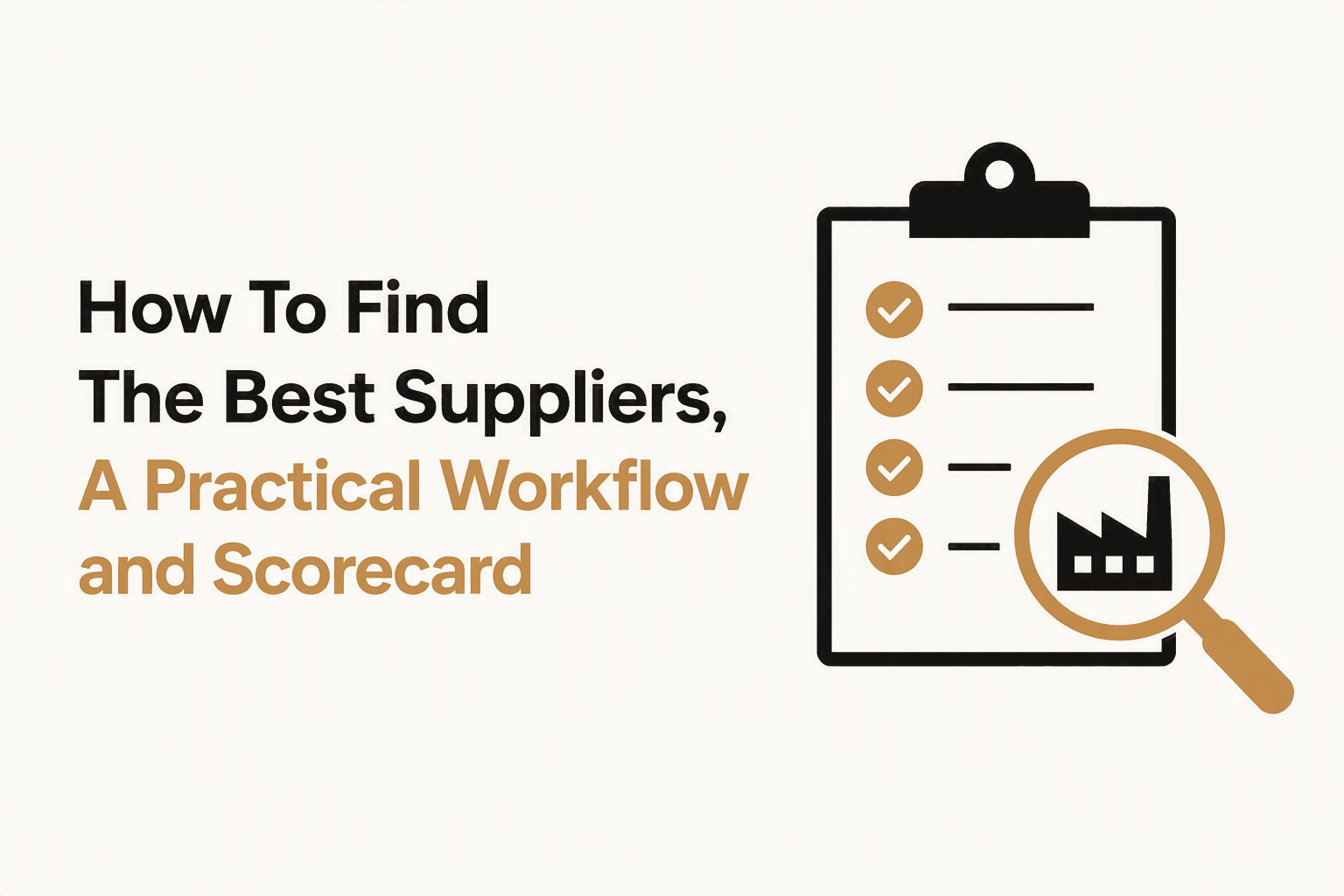
How To Find The Best Suppliers, A Practical Workflow and Scorecard
Learn how to find the best suppliers using a repeatable checklist, vetting steps, and a simple weighted scorecard for objective comparison.
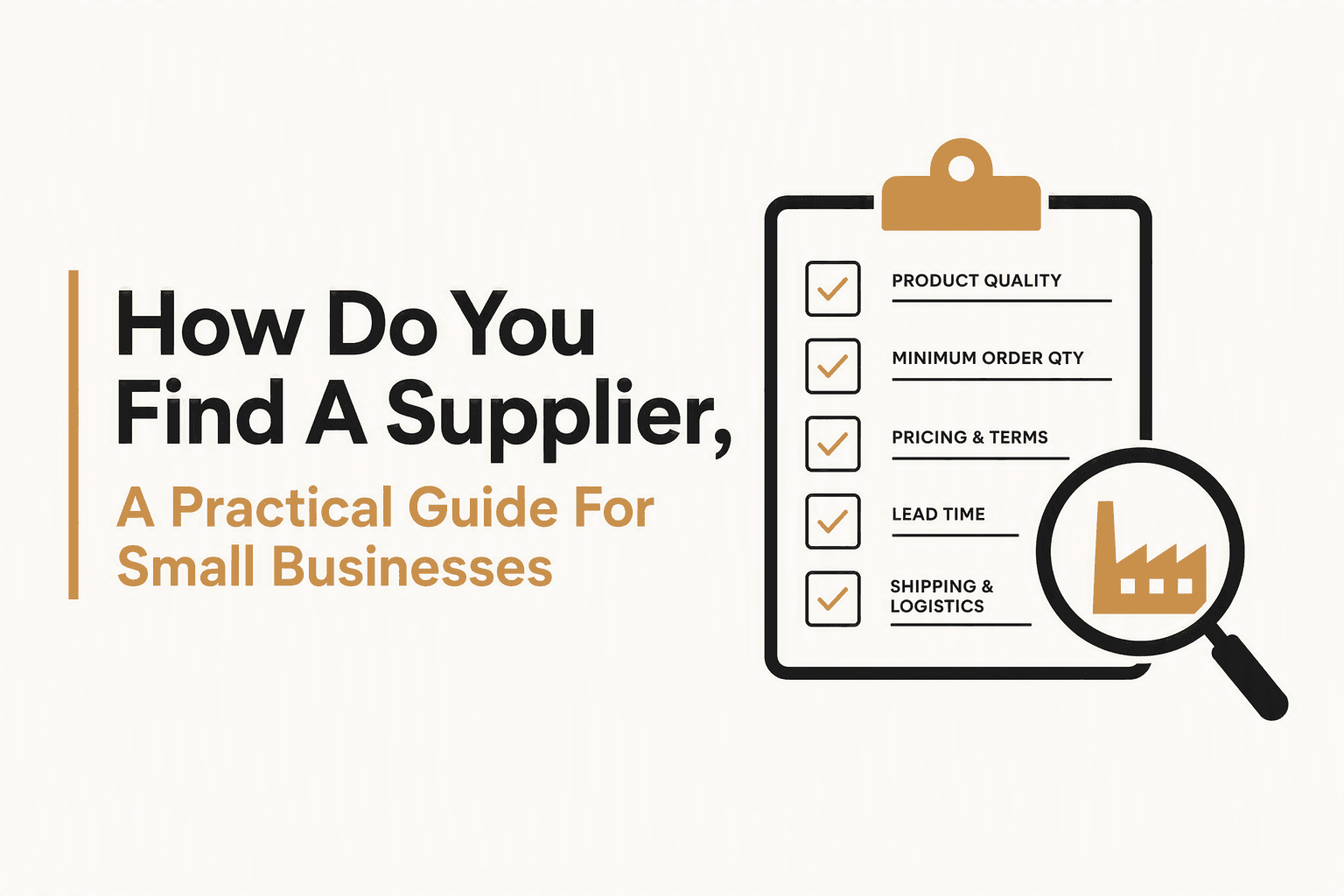
How Do You Find A Supplier, A Practical Guide For Small Businesses
Learn how do you find a supplier with a simple SOP: set requirements, search channels, email RFQs, compare quotes, verify, and place your first order.
Purpose Of Supplier Evaluation Explained, The 5 Reasons It Matters
Learn the purpose of supplier evaluation, how it works in sourcing, and how to build a simple scorecard with weighted criteria for better decisions.